"Rafael was a fantastic tour guide, we absolutely loved our tour. He made it very interesting and funny and was happy to answer any questions we might have had. We really enjoyed it, we definitely want to come back once the weather is not so hot! Pompeii is huge and we feel we saw only a small portion of it, which is understandable with a group tour and 40C heat."
Two Buried Cities · One Day · Departures From Naples, Rome & Sorrento
Pompeii and Herculaneum Tour
Pompeii is the one everybody books. Herculaneum is the one people come back raving about. Seeing both in a single day is a transport problem before it is a sightseeing one — and the answer depends entirely on which town you wake up in.
Top rated
From
$134
per person
Free cancellation
- 4.8 / 5 1197+ Reviews
- 2 Roman Cities In a Single Day
- Both Tickets Included, Skip-the-Line
- Free Cancellation
The Experience
What the From-Naples Tour Includes
Lifted straight from the operator's own listing — the minibus, both entrance tickets and the guided walk through each site.
Highlights
- Explore the ruins of Pompeii & Herculaneum with an archaeologist guide
- Avoid the long lines with skip-the-line tickets to save your time
- Travel in a modern minibus with a professional English-speaking driver
What's Included
- Transportation by shared minibus
- Pompei Express" entrance ticket
- Herculaneum entrance ticket
- Archaeologist guide
- Tolls and parking expenses
- Exclusive branded welcome kit and discount card for Maximall Pompeii giving access to special offers
How a Two-Site Day Actually Works
Four moving parts: get to Campania, do the smaller site, cross the 13 km between them, then walk the big one.
Pick Your Origin Before You Pick Your Tour
This is the decision that shapes the whole day, and almost every listing skips it. From Naples the round trip is short enough that both sites get a full two hours. From Rome you are adding roughly 140 minutes of train travel on top of the same visit. From Sorrento, Salerno or the Amalfi Coast you are further out again. Choose the origin first; the tour follows from it.
Do Herculaneum First, If You Can
The Naples departure runs Herculaneum in the morning and Pompeii after the break, and that order is the right way round. Herculaneum is small, dense and shaded by its own excavation pit; Pompeii is vast and almost entirely exposed. Doing the big open site in the afternoon of a Campanian summer is the single most common regret in the reviews.
Cross Between the Two Sites
The two sites sit on the same railway at the base of Vesuvius, and the crossing between them is the one number in this whole day that never varies: EAV's timetable puts Pompei Scavi to Ercolano Scavi at exactly 20 minutes, every run, all day. Organised tours use a minibus instead. Either way, budget the crossing as real time — it is the part of the day that DIY plans consistently underestimate.
Walk Pompeii With Someone Who Knows Where to Stop
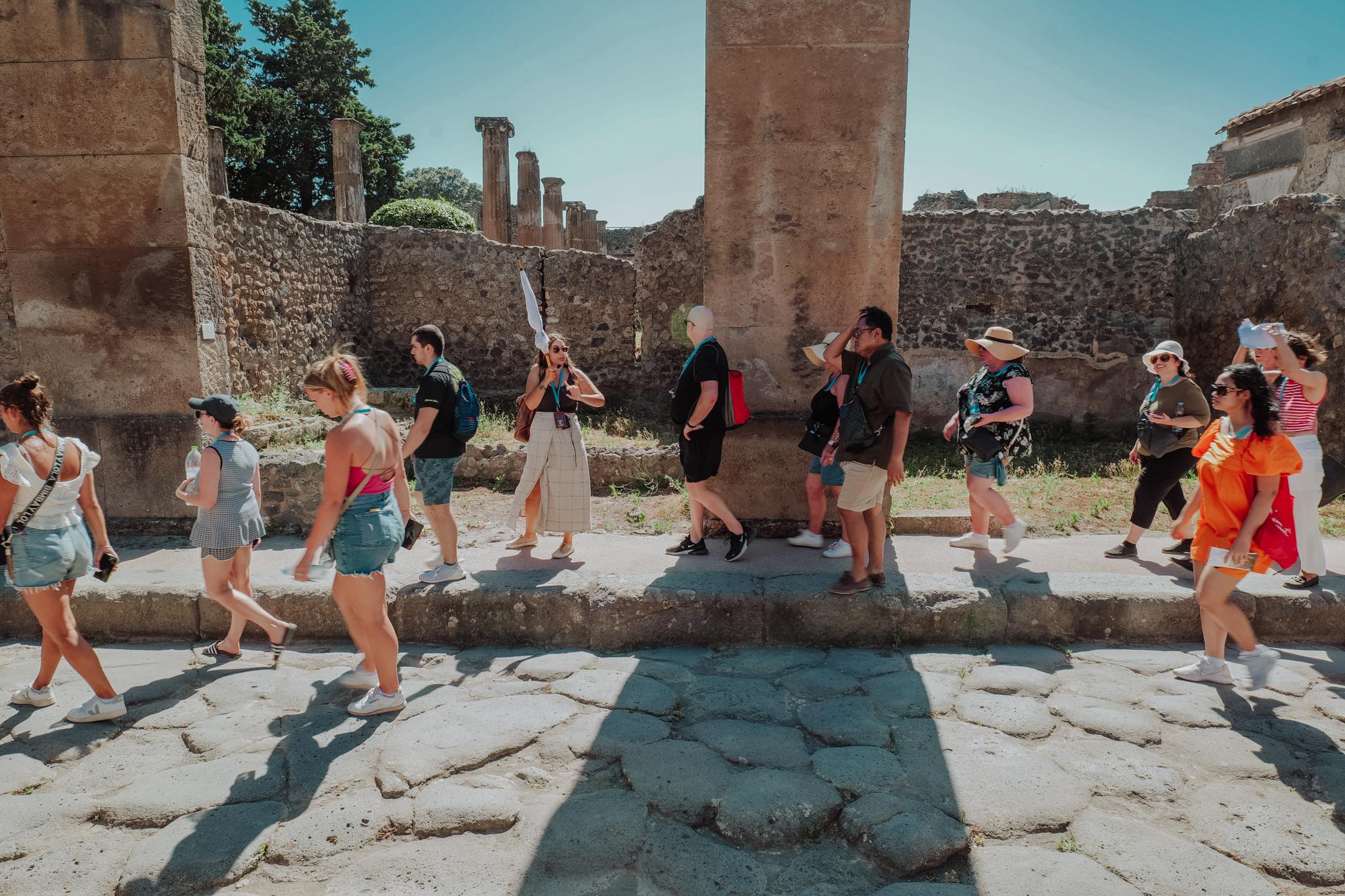
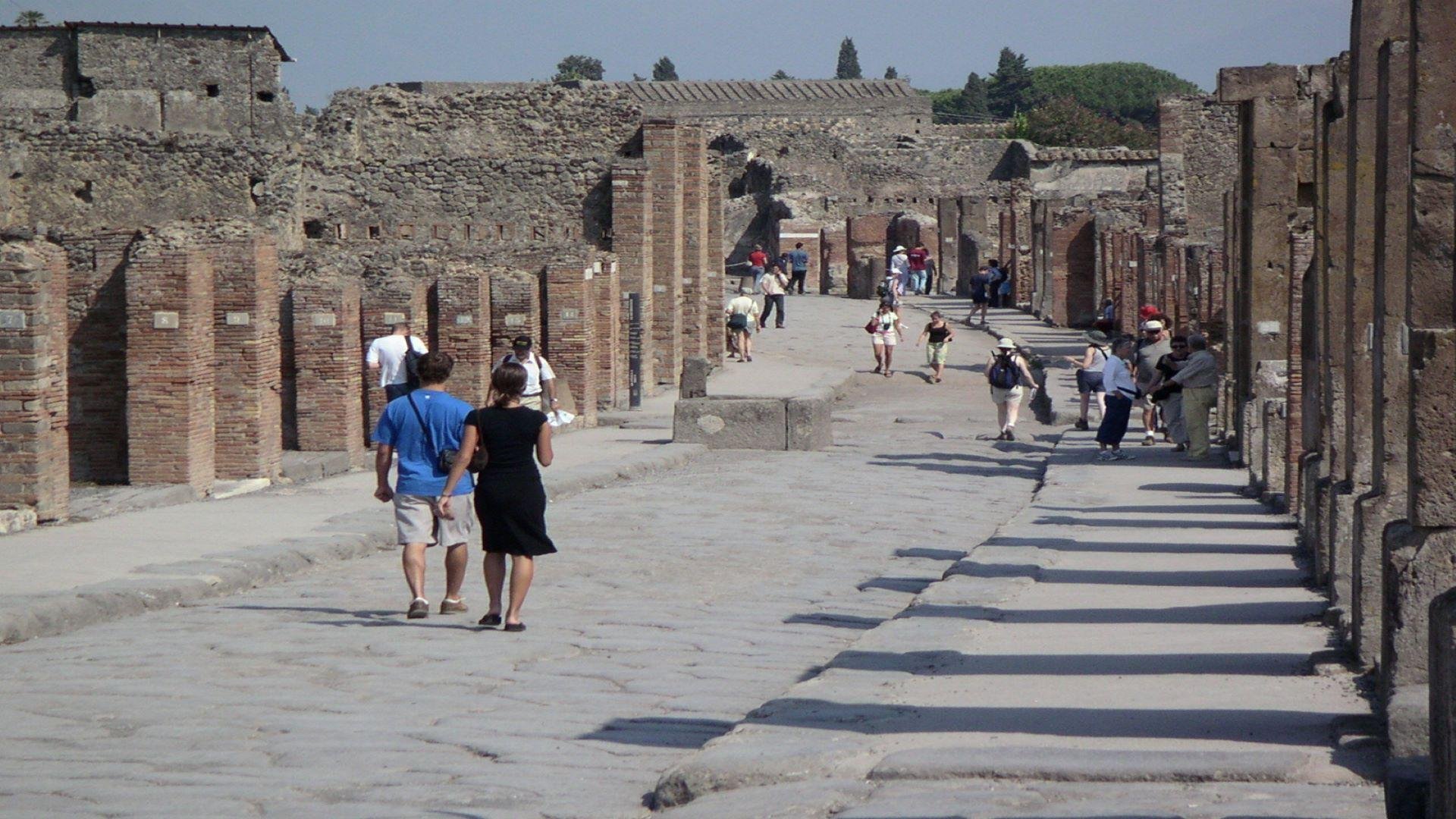
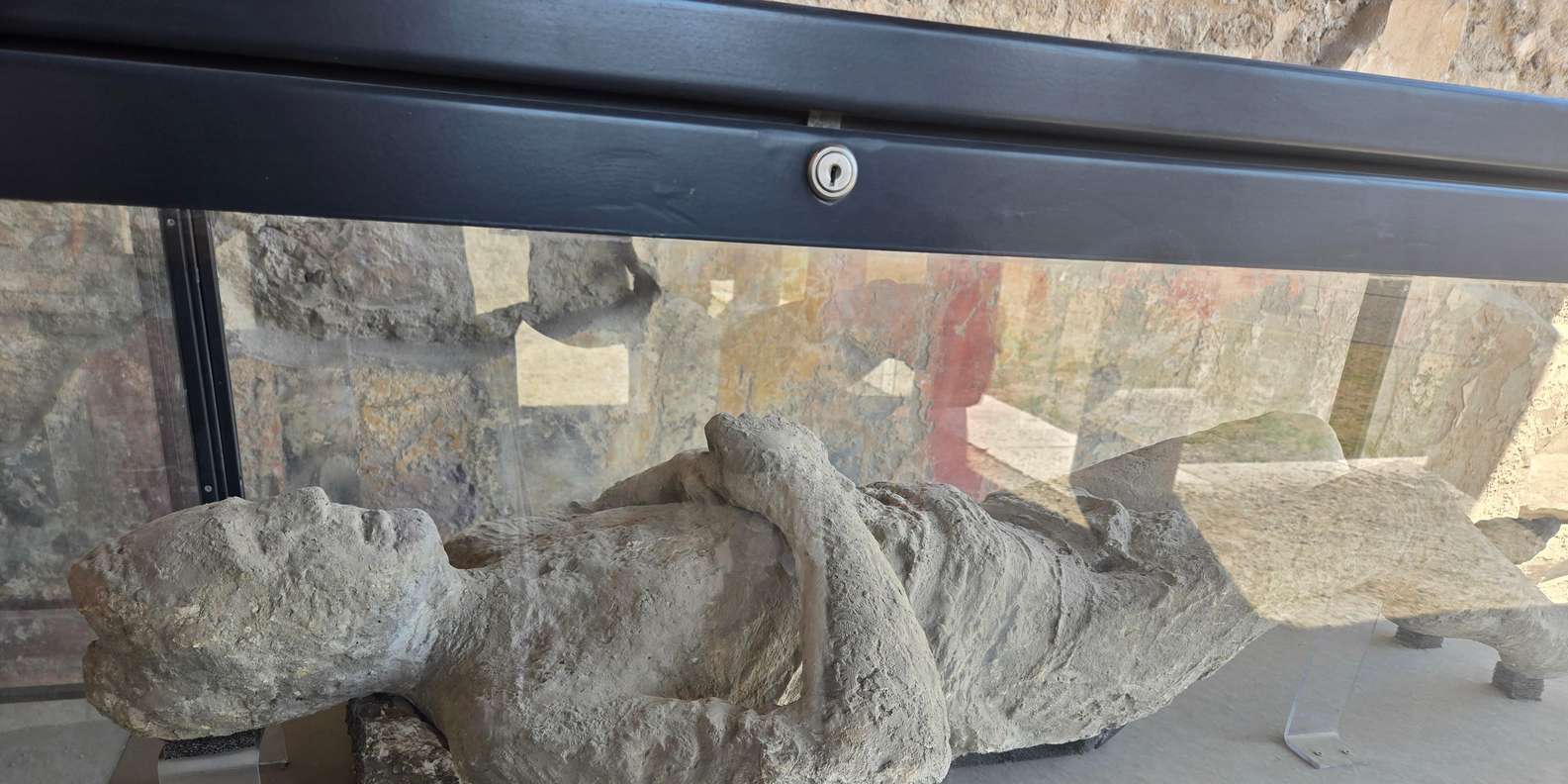
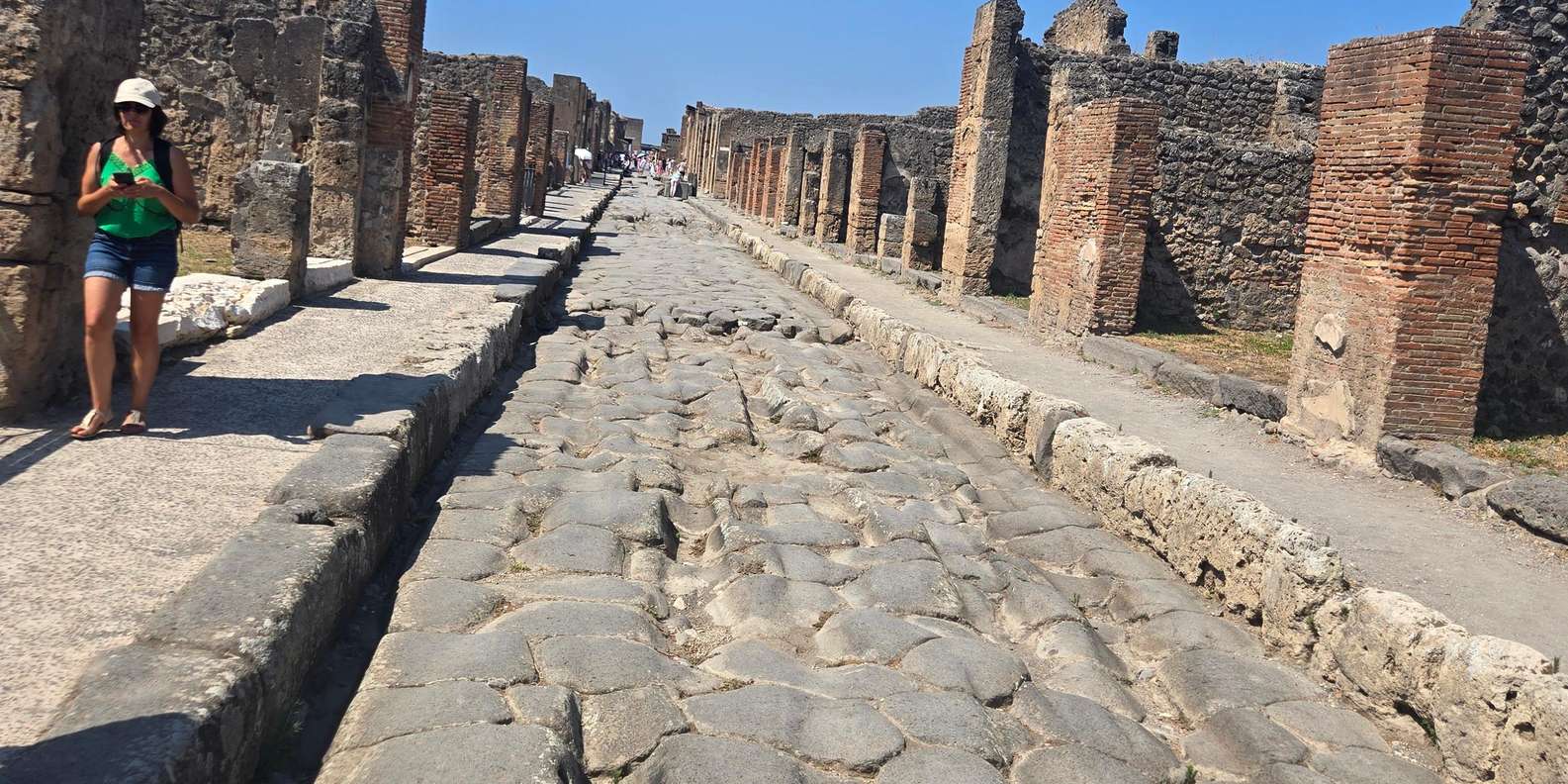
Pompeii is not a building, it is a city — 66 hectares inside the walls, most of it dug out. Without a route you will walk a lot of empty street. The guided walk here is two hours and takes in the Forum, the Forum Baths, the Lupanar, the bakery, the House of the Faun, a thermopolium and the plaster casts, then hands you back to the minibus rather than the ticket queue.
Photo Gallery
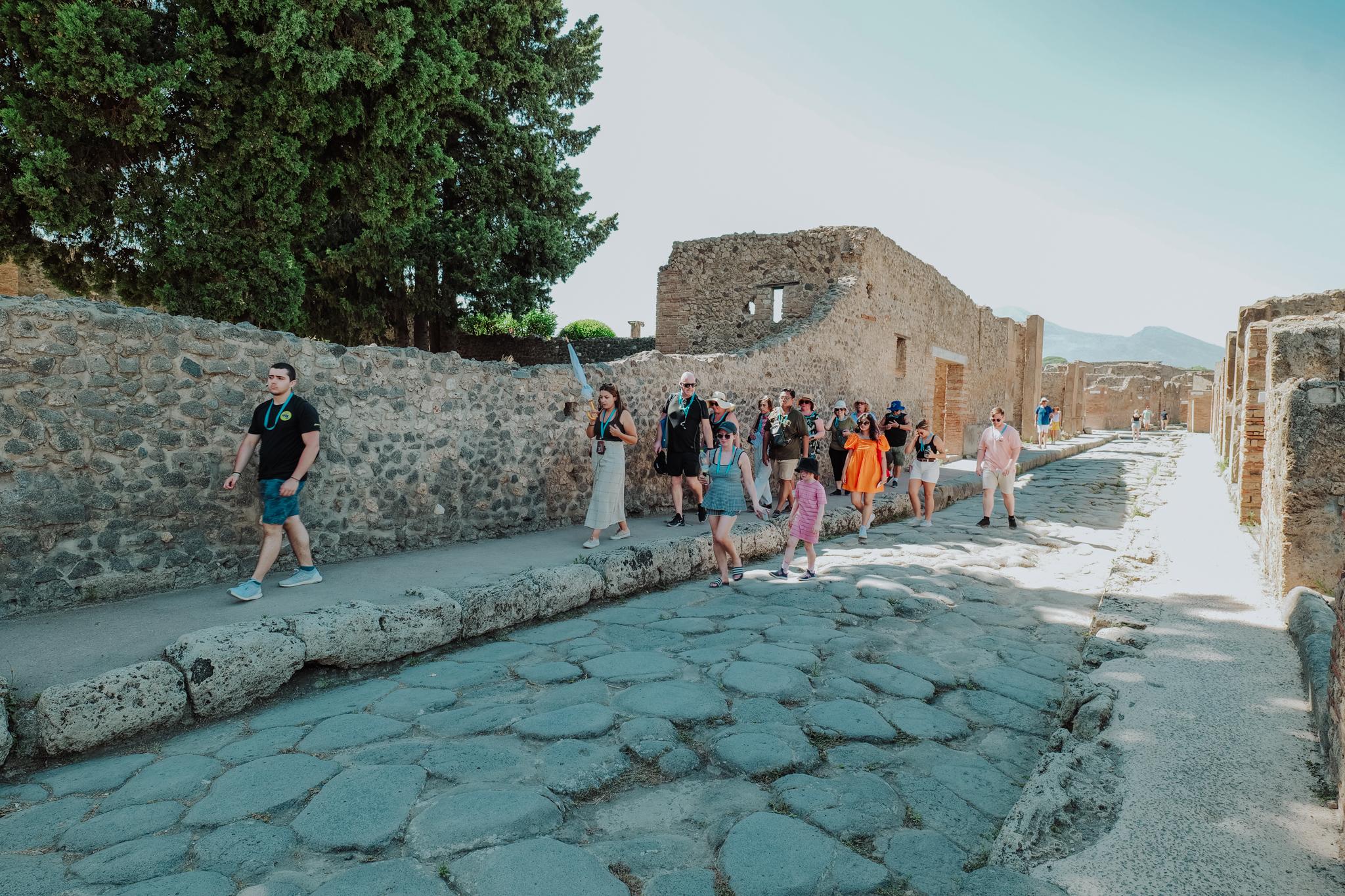
Pompeii and Herculaneum — Through the Lens
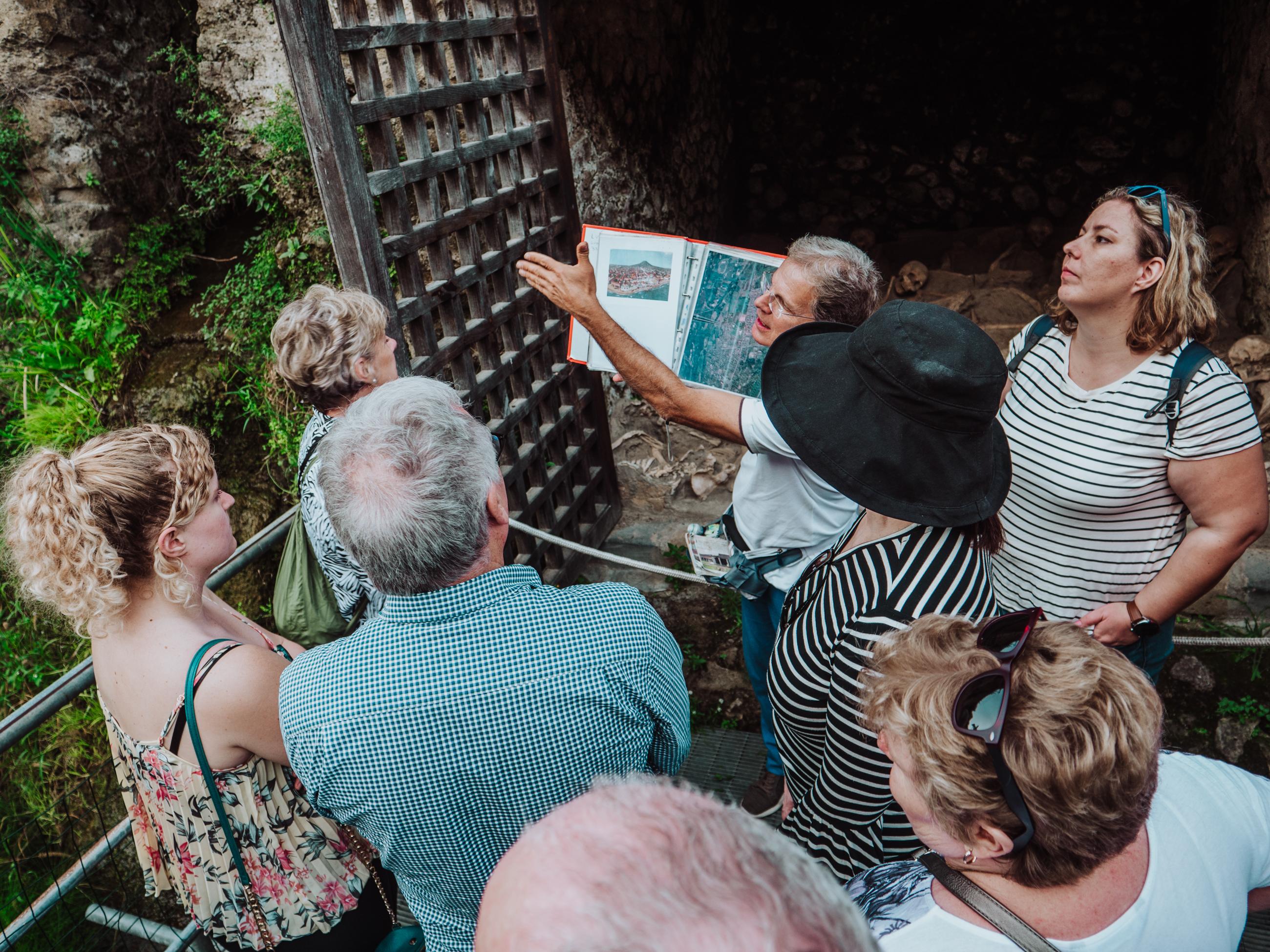
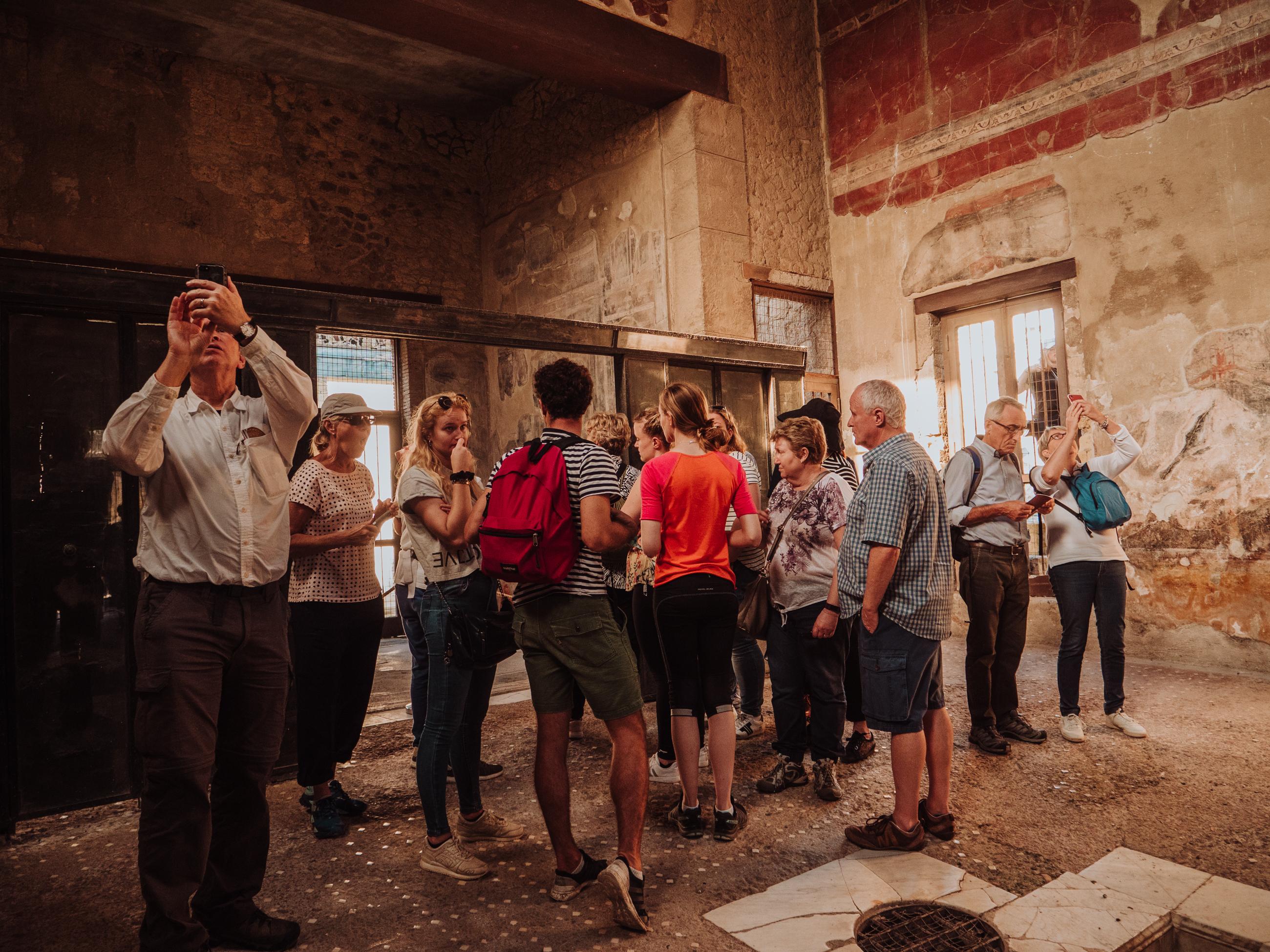
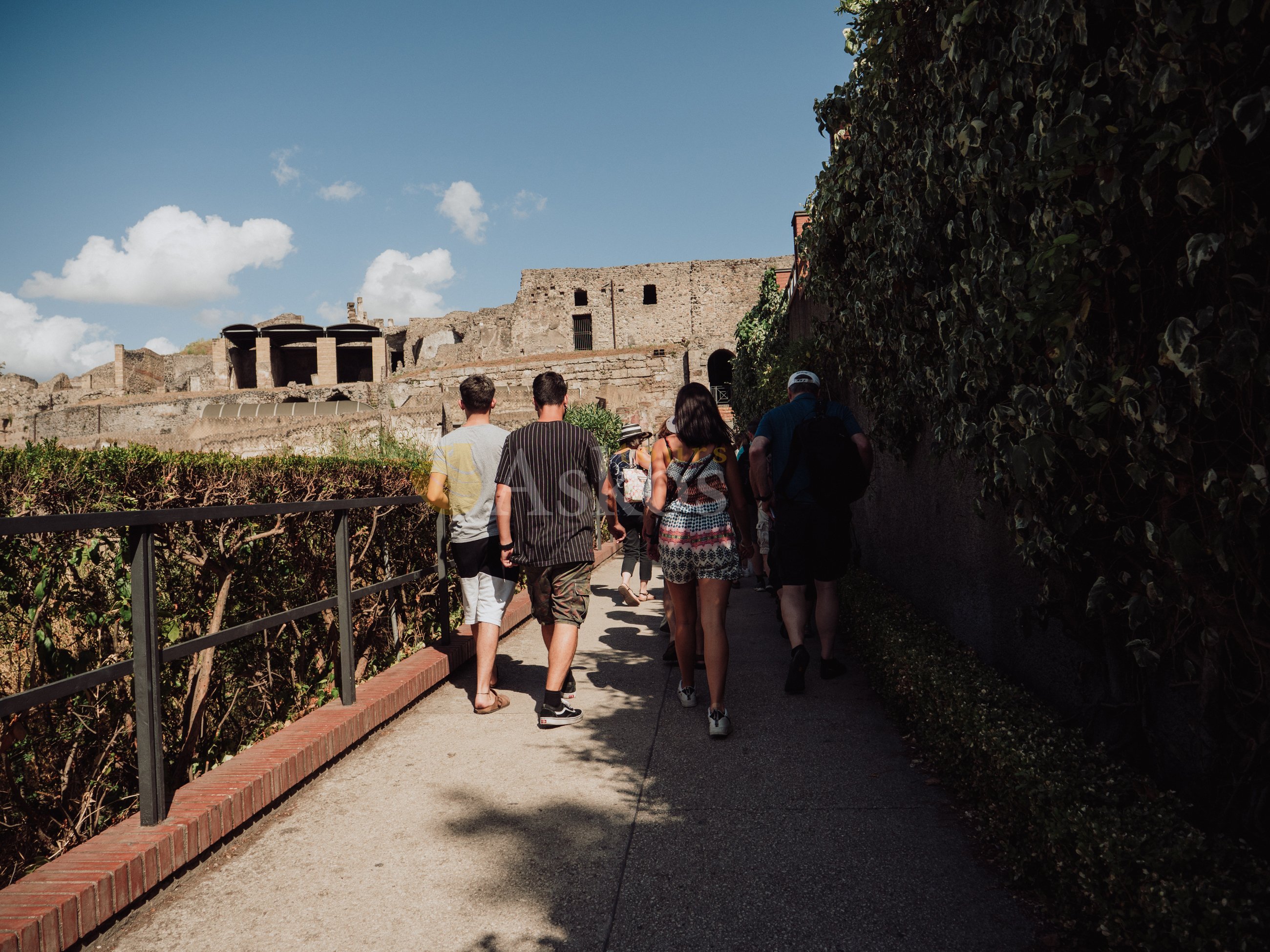
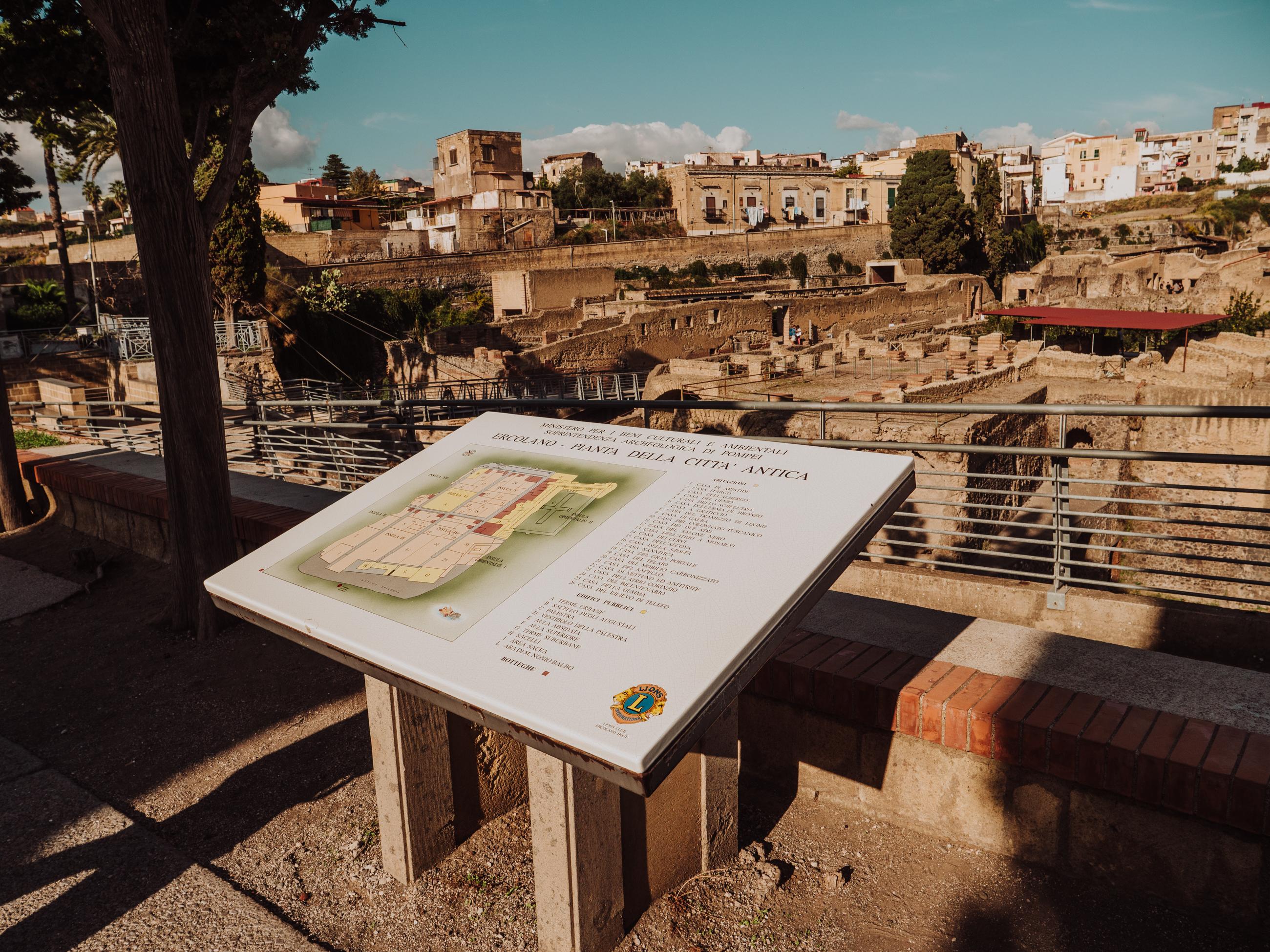
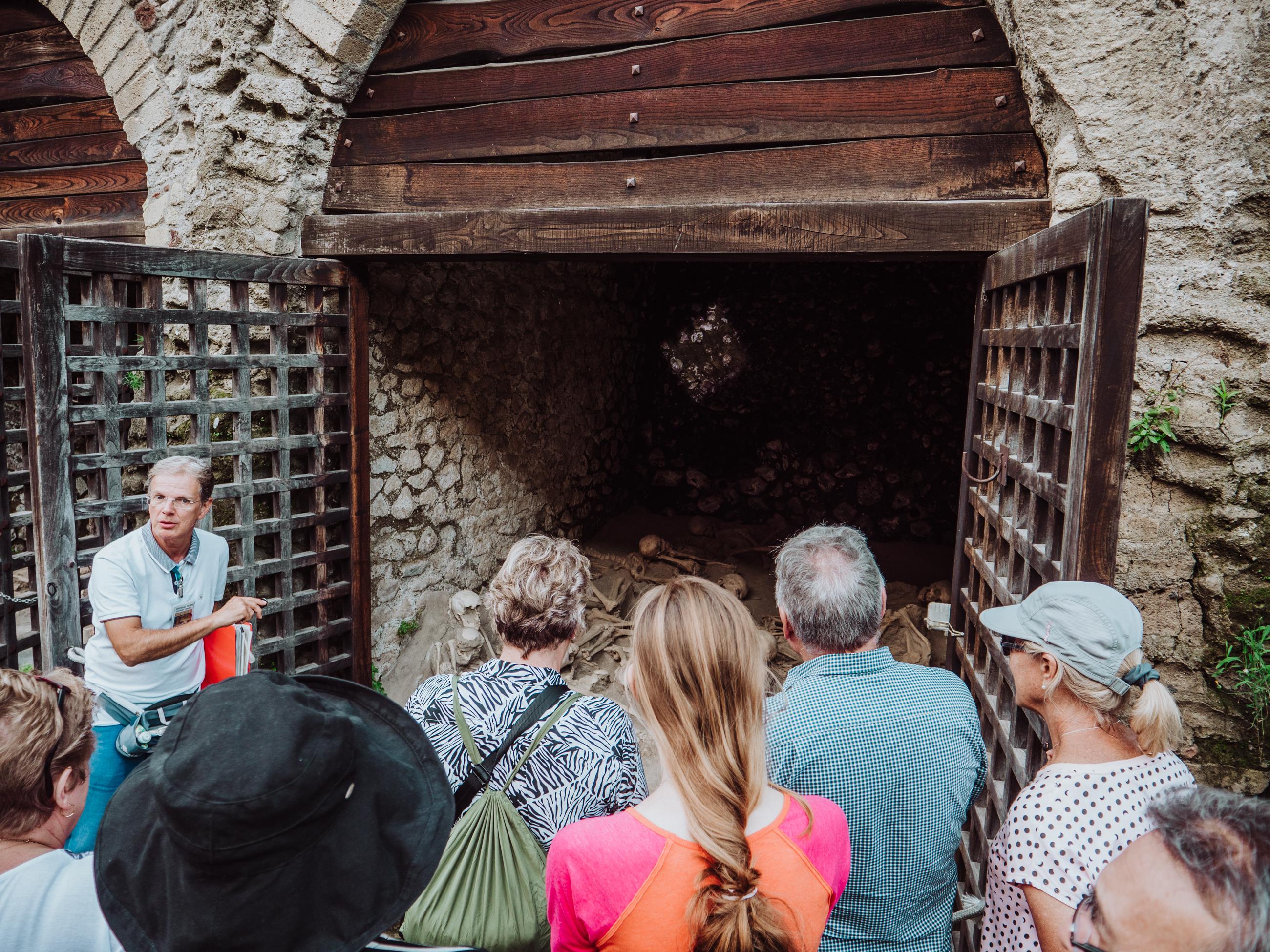
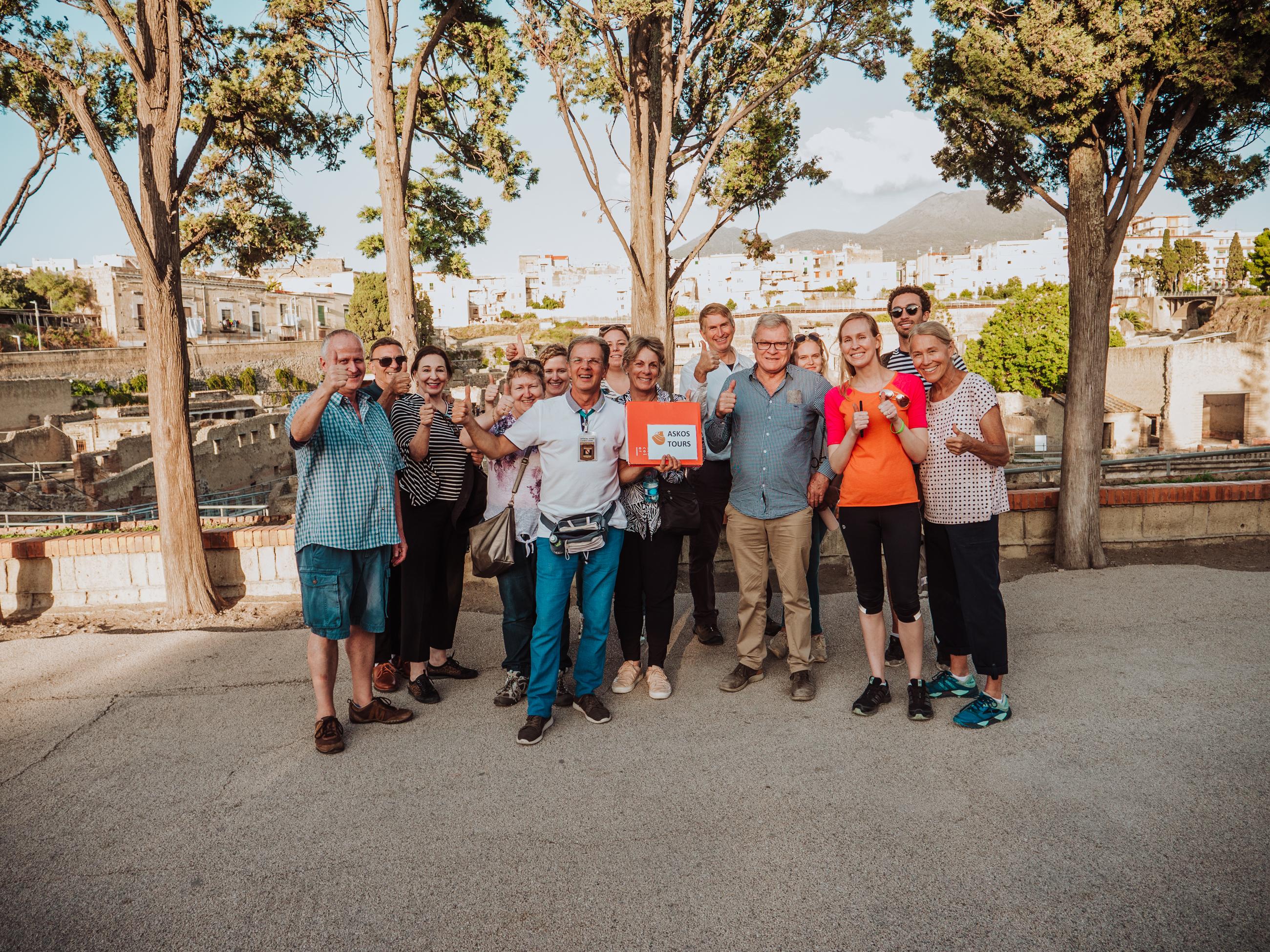
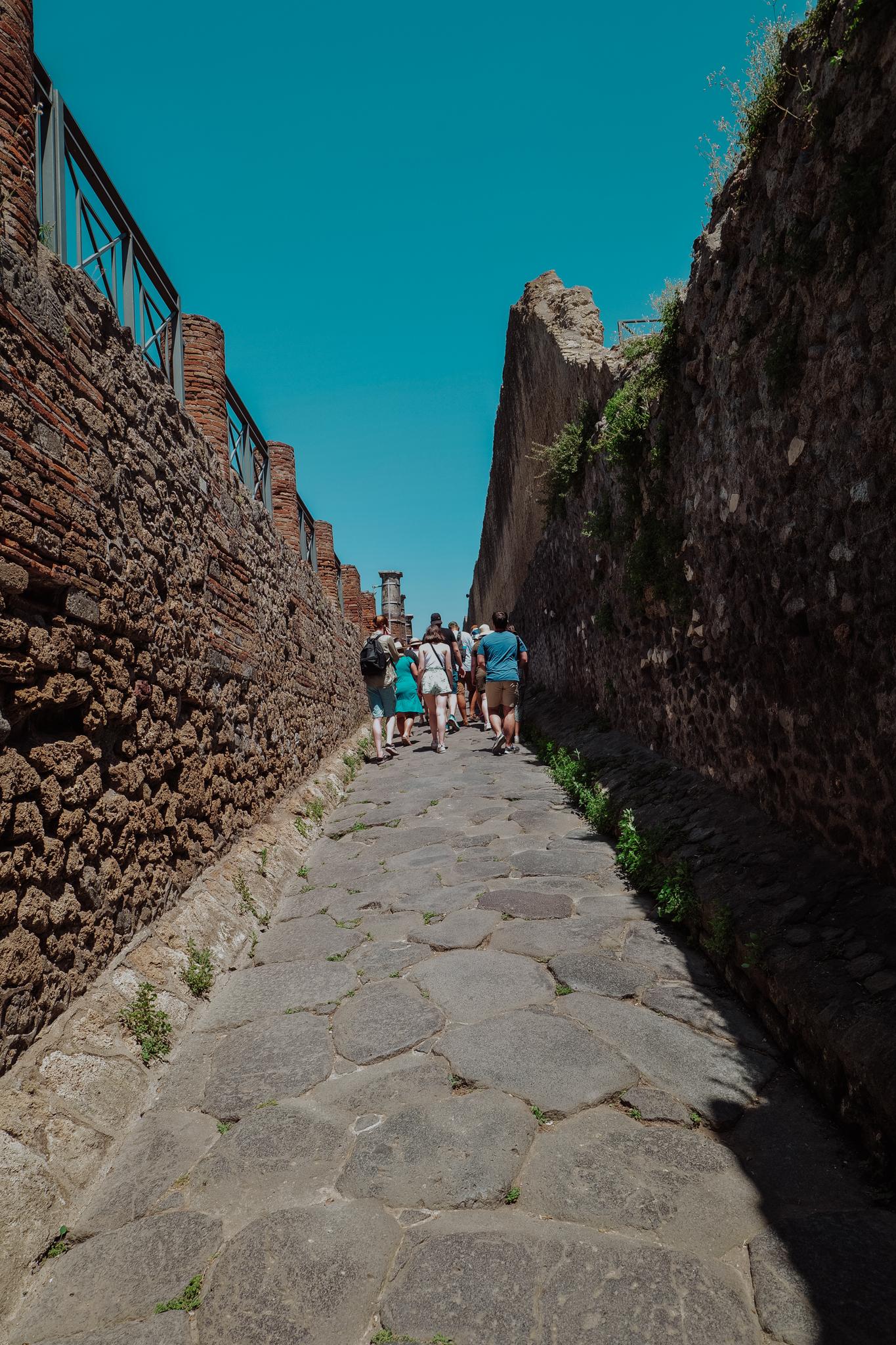
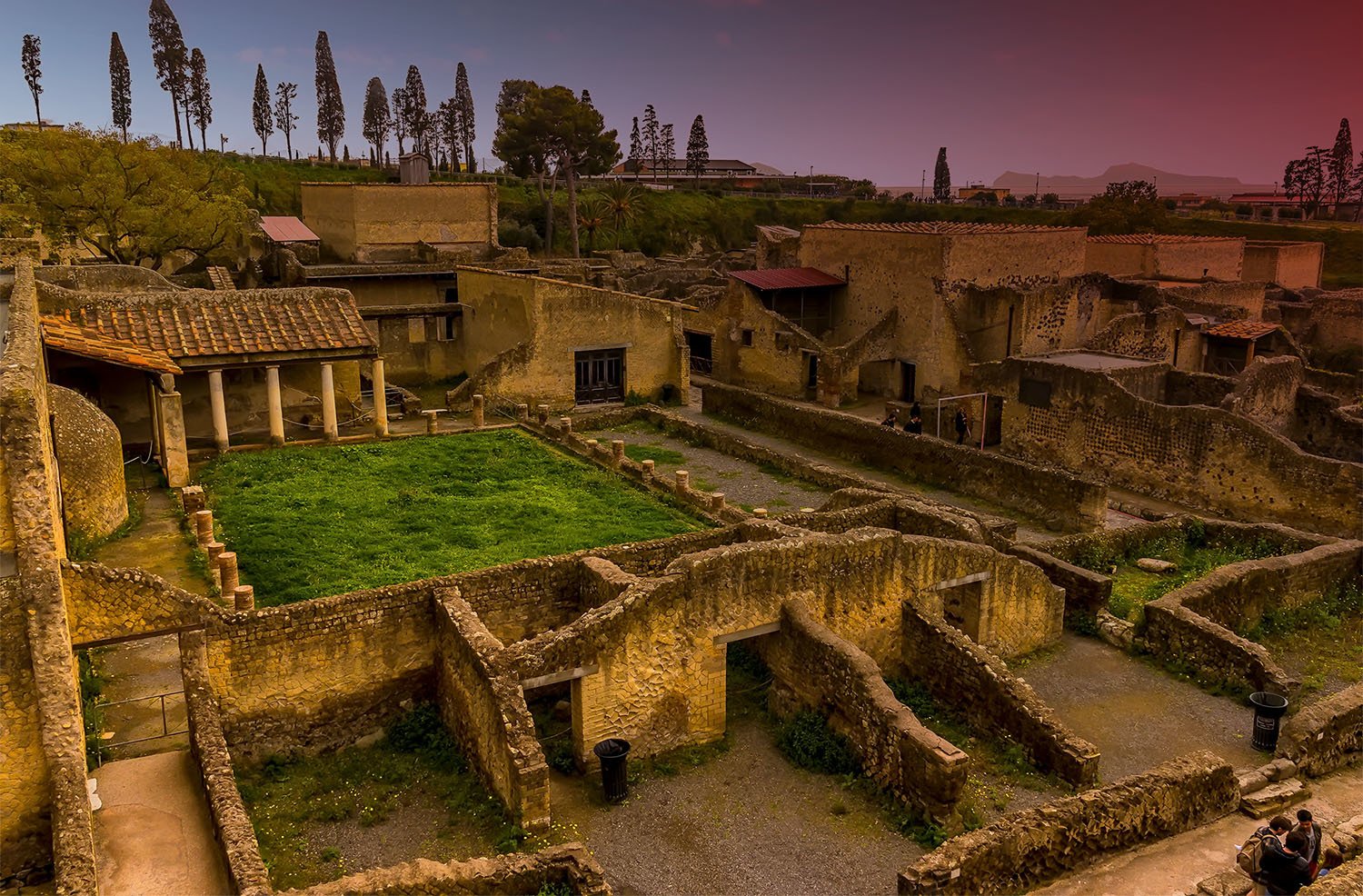
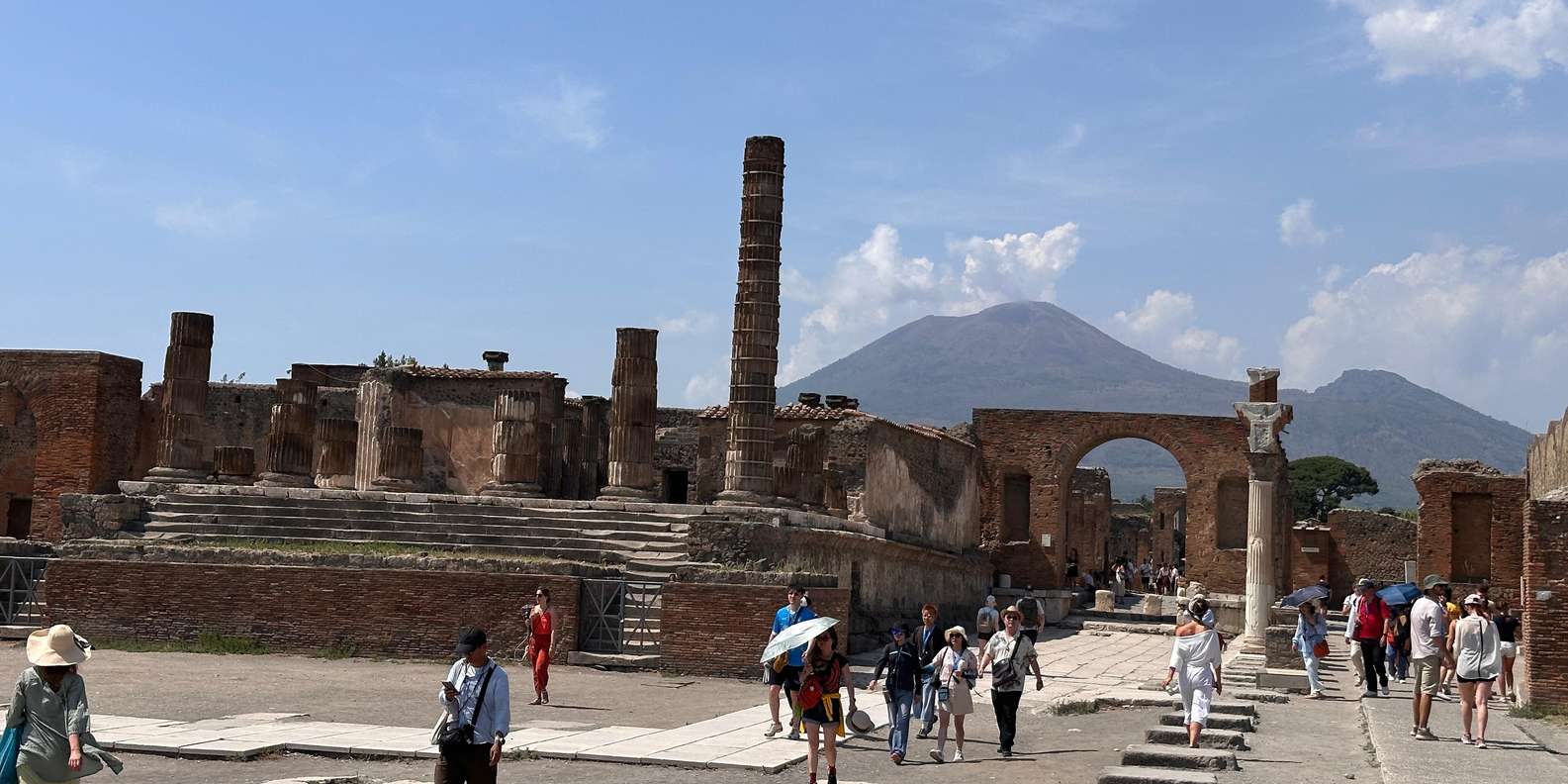
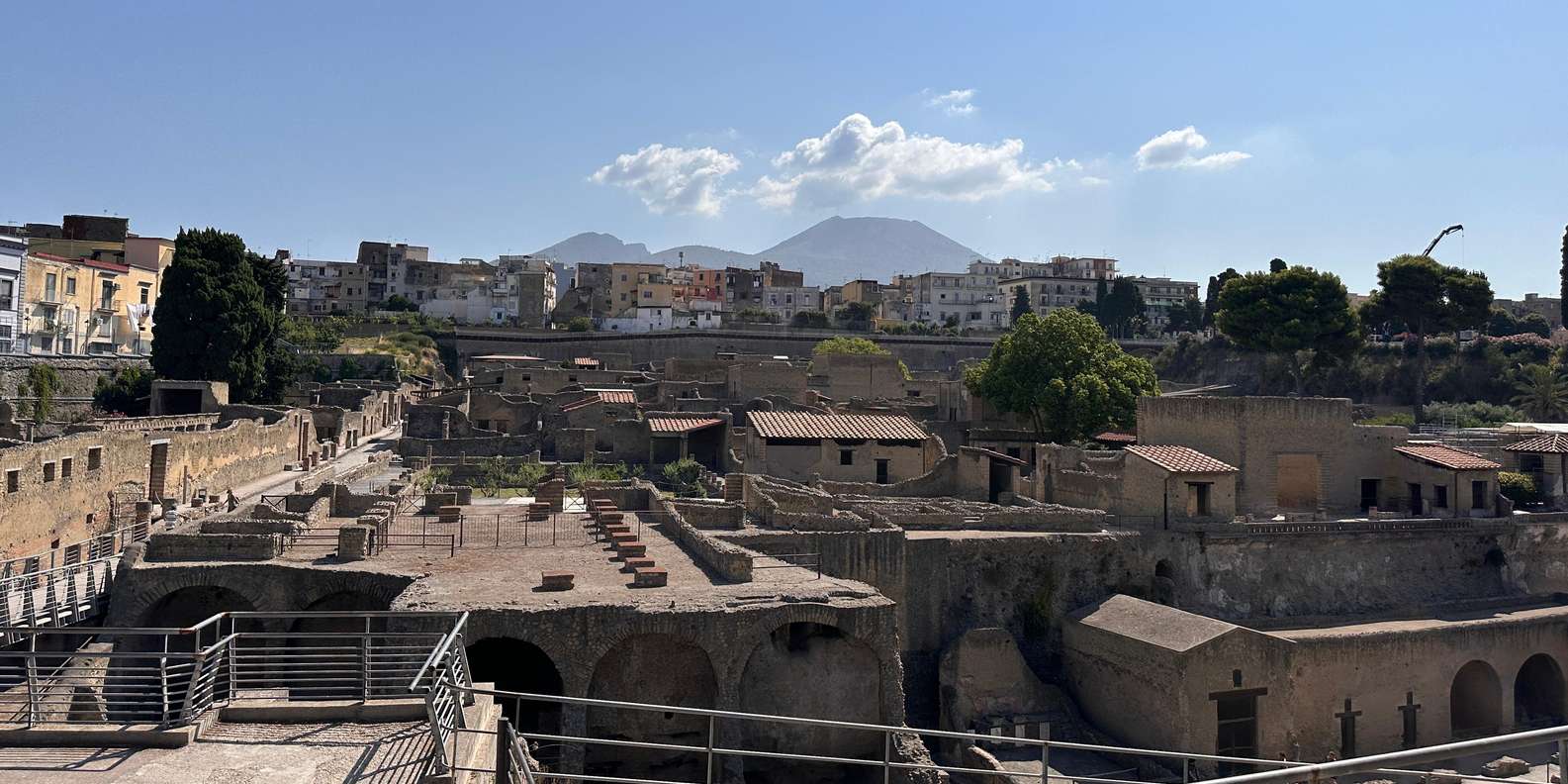
Forum colonnades under Vesuvius, carbonised roof beams, wall frescoes that never saw daylight for seventeen centuries, and the plaster casts.
Book Your Experience
Check Availability & Prices
Select your preferred date and time. Instant confirmation — free cancellation up to 24 hours before departure.
Where Should You Start the Day?
Almost every page about these two sites compares tours. The decision that actually shapes your day is which town you leave from — because that is what determines how many of your eight hours are spent looking at ruins rather than at a window.
| Feature | SHORTEST DAY From Naples | From Rome | From Sorrento or the Coast |
|---|---|---|---|
| Starting Price | From $134/per person | From $236 per person, with round-trip high-speed rail inside the price | From $134 per person from Sorrento; the Amalfi Coast departures run higher |
| Travel Time, Each Way | 29–36 minutes to Pompeii on the Circumvesuviana, 14–15 to Herculaneum — the shortest reach of any origin | About an hour to Naples on a Frecciarossa or Italo, then ground transport in Campania on top | 33–40 minutes Sorrento to Pompeii. From Positano or Amalfi it is closer to two hours each way, with a change |
| How Much of the Day Is Transport | Roughly an hour and a half in total. Both sites get their full two hours and you are back for dinner | Two and a half hours of rail before you count the road legs. This is a genuinely long day, not a long morning | Two to four hours depending on where on the coast you start. Positano and Amalfi have no direct link at all |
| What You Give Up | Nothing much — except that you have to be in Naples, which not everyone wants to be | Time, and flexibility. Miss the return and you are improvising in a city you did not plan to sleep in | Reliability. In August the coast bus is often full at intermediate stops and you may not be able to board |
| The Catch Nobody Mentions | The Circumvesuviana is cheap and frequent and genuinely unreliable — delays of half an hour are routine, and the line is a known pickpocket route | There is one direct Rome-to-Pompeii Frecciarossa, and it runs on Sundays only. Every other day you are changing in Naples | If you are driving the SS163 yourself in August or September, the alternate-plate rule bans half of all cars between 10:00 and 18:00 |
| Best For | Anyone who can spend one night in Naples. It is the cheapest, shortest and most flexible way to see both cities | Travellers whose trip is Rome-shaped and who accept a twelve-hour day to add the archaeology | People already on the peninsula for the coast, who want the ruins without relocating |
| Booking Ahead | Yes. Pompeii caps entries at 20,000 a day, issues named tickets, and caps the morning slot separately | Yes, and earlier — the rail seats and the site slot both have to line up | Yes, and check the ferry season: the Sorrento-side crossings are roughly April to early November only |
| Check Availability | See the Rome Departure | See the Sorrento Departure |
More Options
Other Ways to Do Pompeii and Herculaneum
Different origins, different budgets, and the Pompeii-only tickets that make sense if you decide one ruined city is enough. All with free cancellation and instant confirmation.
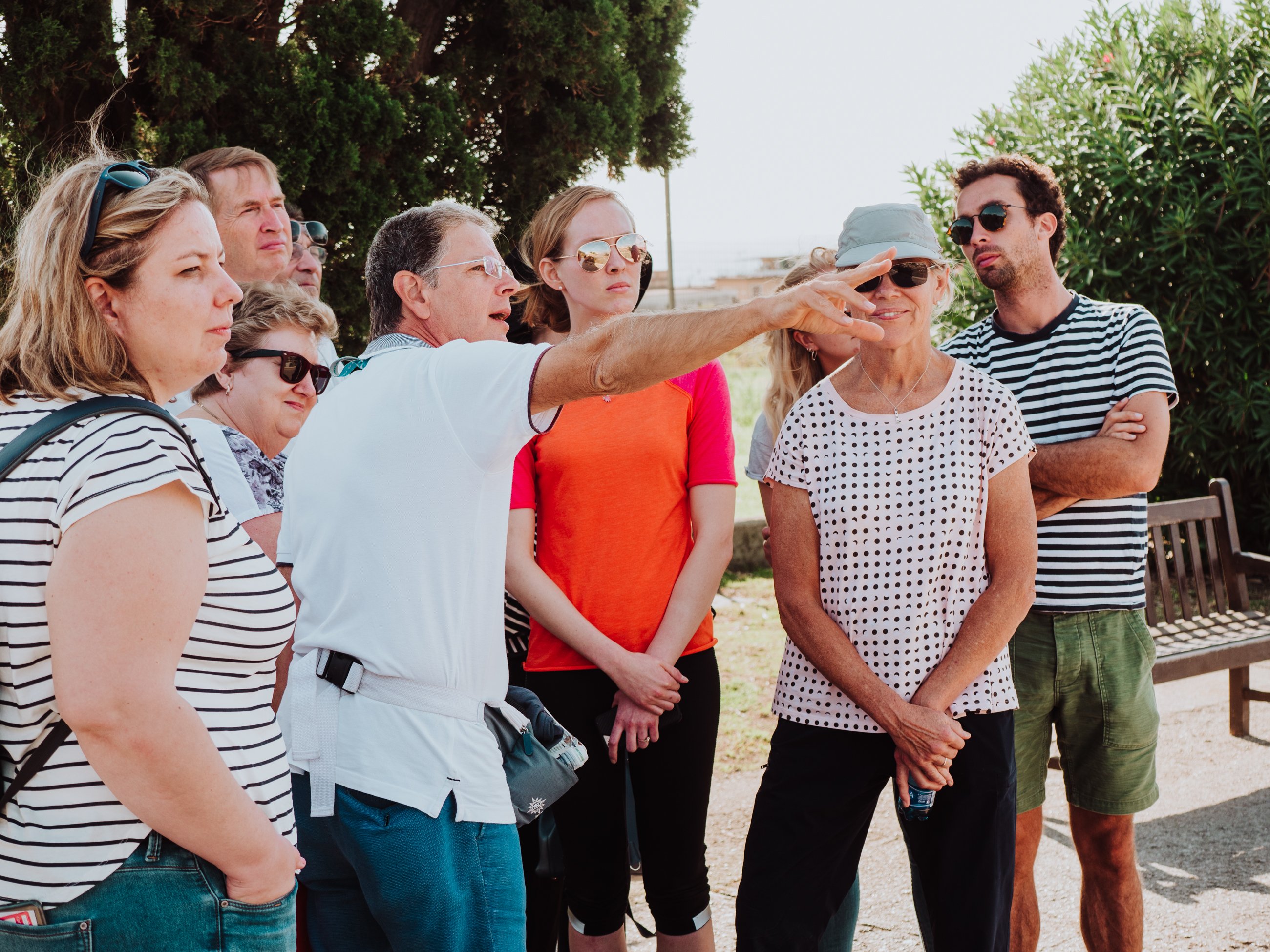 TRAIN, NOT MINIBUS
Pompeii: Small-Group Tour of Pompeii and Herculaneum
This tour consists of a pleasant walk around the ancient Roman cities of Pompeii and Herculaneum, buried by the ashes of the volcano Vesuvius in 79 A.D. Your tour …
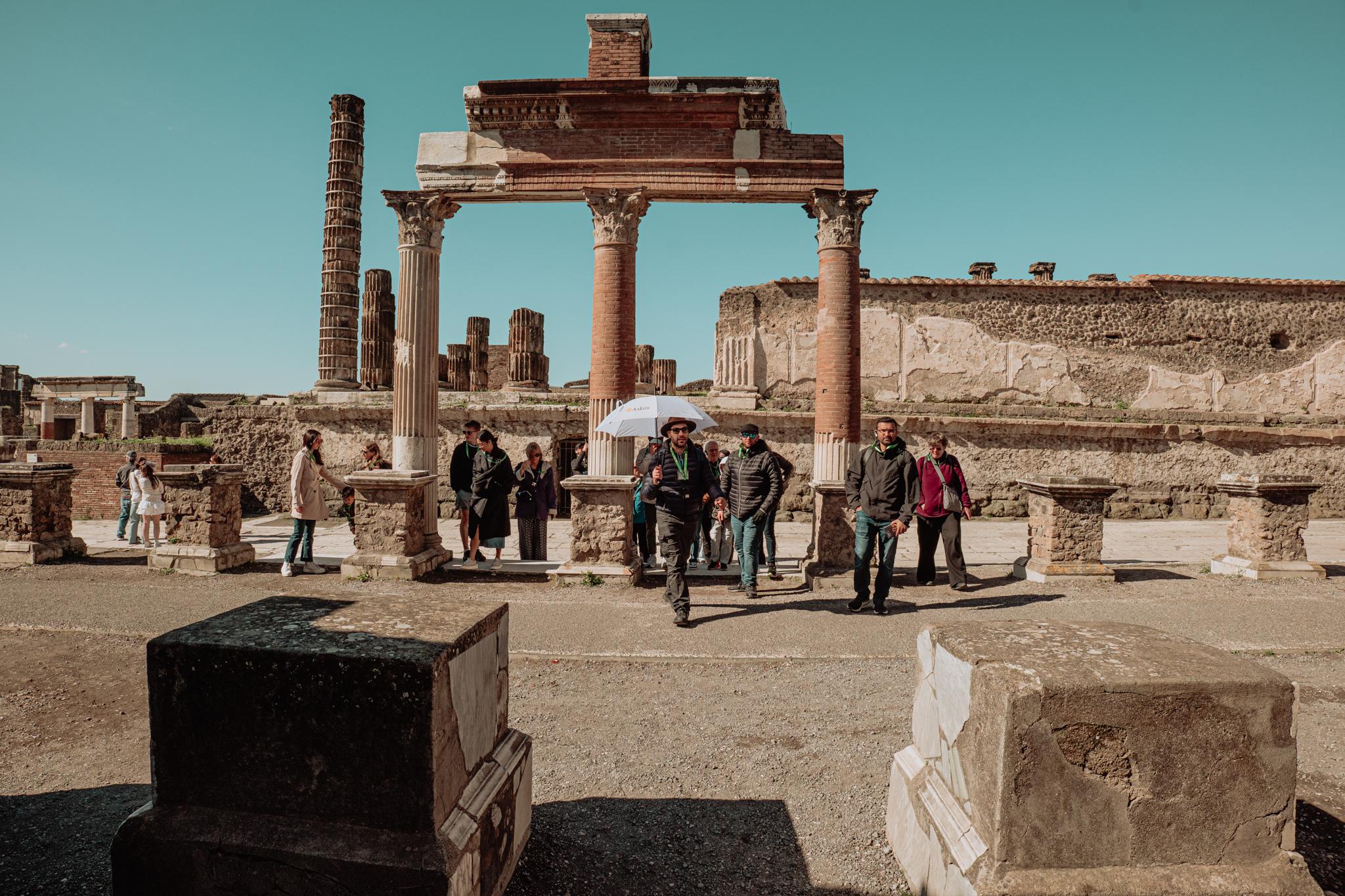 FROM ROME
From Rome: Pompeii and Herculaneum by High-Speed Train
Catch a fast train with your pre-booked tickets from Roma Termini Station to Naples and enjoy a guided tour of Pompeii and Herculaneum in a small group. Escape the …
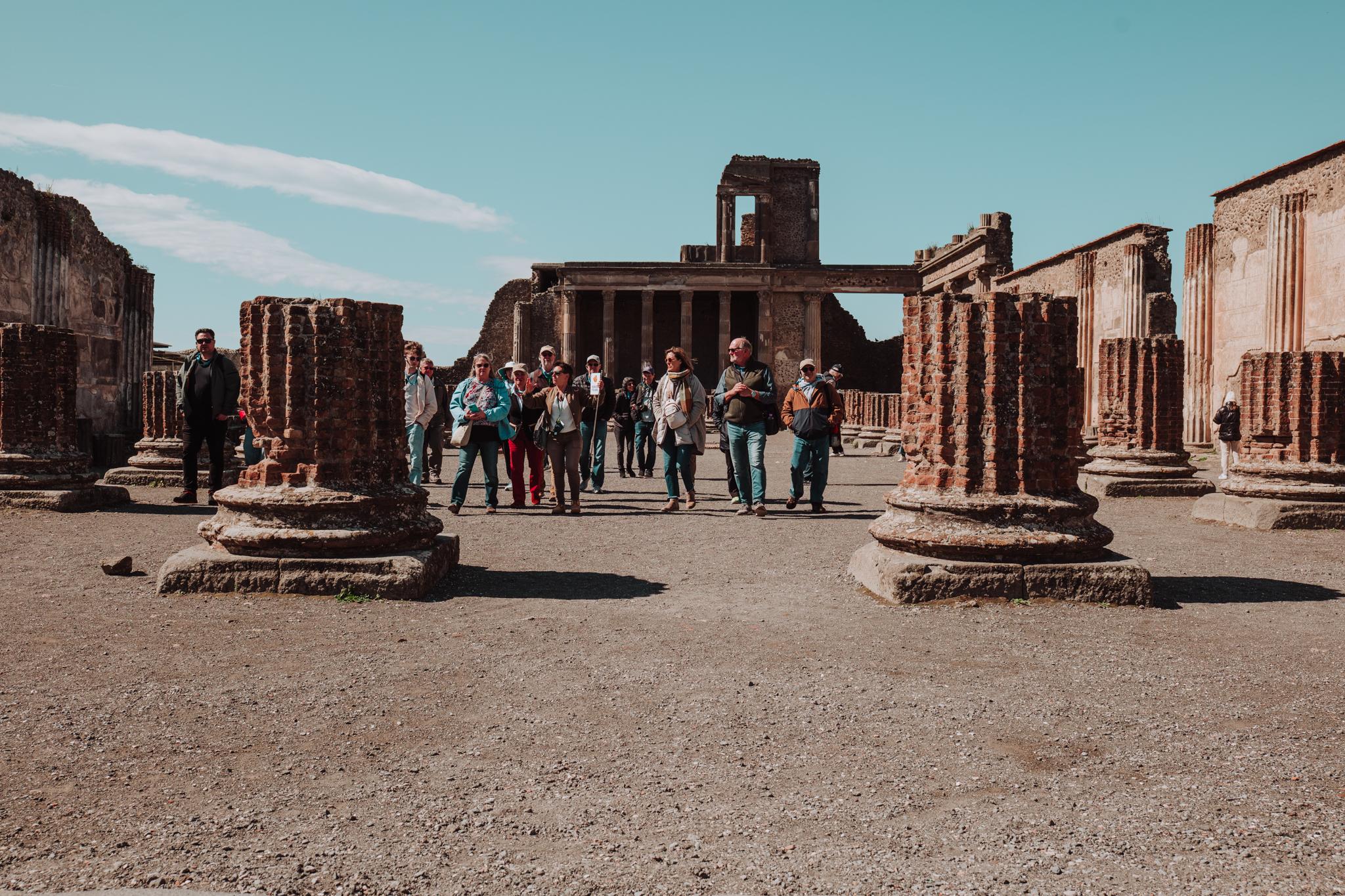 FROM SORRENTO
Pompeii and Herculaneum small group excursion from Sorrento
Embark on an unforgettable journey to the ancient Roman cities of Pompeii and Herculaneum on this small-group tour departing from Sorrento. Travel in a modern, …
 WITH LUNCH
Pompeii and Herculaneum Guided Tour with Local Lunch
When Mount Vesuvius erupted in 79 AD, the ancient cities of Pompeii and Herculaneum were buried beneath layers of volcanic ash and debris, preserving a remarkable …
 FROM THE AMALFI COAST
From Amalfi Coast: Pompeii Herculaneum skip-the-line
Meet your local guide for the day and board on the coach to depart to Pompeii, passing the beautiful towns along the Amalfi Drive. When you arrive at Pompeii, you’ll …
 POMPEII ONLY
Pompeii: Entry Ticket and Guided Tour with an Archaeologist
Join a small group tour through the captivating ruins of Pompeii, which was buried in 79 AD by the eruption of Mount Vesuvius. This 2-hour walking tour is led by an …
The Independent Guide
Which Origin Should You Depart From?
Naples, Rome, Sorrento, Salerno, Positano, Amalfi or a cruise berth — the same two cities, seven very different days. This is what each one actually costs you in hours.
Ask the internet about a Pompeii and Herculaneum tour and you get a list of tours. That is the wrong first question.
The two sites are fifteen minutes apart by road and twenty minutes apart by train. They are open the same hours, they cost €20 and €16 at their own gates, and every guided product on this page walks broadly the same route through each of them. What actually differs between a good day and a wasted one is where you start it. Depart from Naples and roughly ninety minutes of your day is transport. Depart from Positano and you can spend four hours in transit to see two sites that take four hours to visit.
Google knows this even if the tour listings do not. Seven of the ten things people type after pompeii and herculaneum tour are origins — from naples, from sorrento, from rome, from salerno, from amalfi, from positano, from naples port. This page answers that question first, with the timetables and fares that make it answerable, and only then gets to which tour.
The seven origins, honestly ranked
| You are staying in | Getting to Pompeii | Round-trip travel | Direct link to the sites? | Verdict |
|---|---|---|---|---|
| Naples | Circumvesuviana, 29–36 min, €3.30 | ~1h30 | Yes, both sites | Best base. Nothing else is close |
| Sorrento | Circumvesuviana, 33–40 min, AC-band single | ~1h20 | Yes, both sites | Excellent — as good as Naples, on a prettier line |
| Salerno | Trenitalia regional, 23 min, then a €1.50 shuttle | ~1h30 | To the town, not the gate | Underrated. Fastest train of the lot |
| Naples cruise port | Walk or taxi to Garibaldi, then the train | ~3h | Yes, with a transfer at the start | Doable in a ship day. Budget two hours each way in August |
| Rome | Frecciarossa or Italo to Naples, ~1h, then road | ~2h30 rail alone | Sundays only, direct | A twelve-hour day. Worth it once, if you accept that |
| Positano | SITA bus to Sorrento, then the train | ~4h | No | Take a tour or a transfer. Public transport is a bad idea |
| Amalfi | SITA bus to Salerno or Sorrento, then the train | ~4h30–6h | No | Same answer, more emphatically |
Those are door-to-gate figures including a realistic connection wait, not marketing times. The two “no” rows are the important ones, and they are not opinion: the Pompeii park’s own access page lists every public connection to the site — two Circumvesuviana lines, the Trenitalia stop, the Pompei Link shuttle, SITA services from Naples and Salerno, Busitalia lines 4 and 50 — and lists nothing at all from the Amalfi Coast. There is a direct SITA coach from Amalfi to Naples, but it runs inland via Vietri, Cava and Nocera and does not stop at Pompeii.
From Naples
This is the answer for most people, and the margin is not close. Naples is 25.9 km from Pompeii and 11 km from Herculaneum, and the Circumvesuviana connects all three.
The numbers from EAV’s own timetable, valid from 28 March 2026: Napoli Garibaldi to Pompei Scavi – Villa dei Misteri takes 29 to 36 minutes, there are 33 departures a day, the first leaves at 05:39 and the last at 22:14, and a single costs €3.30. Herculaneum is even closer — Ercolano Scavi is 14 to 15 minutes out, €2.60. The Pompeii station is essentially opposite the Porta Marina entrance; Piazza Esedra is a 438-metre walk. At Ercolano you turn right out of the station and walk about 500 metres downhill on Via IV Novembre — pleasant on the way there, less so on the way back.
One practical tip that costs nothing: board at Porta Nolana rather than Garibaldi. It is the line terminus, it adds about four minutes, and it is the difference between a seat and standing for half an hour.
Two things to know before you rely on this line. The first is that it is genuinely unreliable — not occasionally, routinely. EAV publishes its own monthly report of cancellations and delays over fifteen minutes, and the live departure board on a normal August afternoon shows Sorrento-bound trains running thirty-four to forty-five minutes late. The director of the Pompeii park himself went public in March 2026 to say that the problem is not the strikes but “le continue inefficienze che si registrano quotidianamente” — the daily inefficiencies — after visitors were stranded in Naples with no information. The second is that this specific line is a well-known target for pickpockets, with warning signage in the stations to prove it.
None of that makes it a bad choice. It makes it a choice you should build slack into — which is precisely what the organised departures do, by putting you in a minibus instead. Our featured departure collects you outside Naples Central and runs Herculaneum first, then Pompeii after a break; the alternative meets you at the Pompeii gate and includes the train hop between the sites. Both are covered properly on the from Naples page.
A middle option: the Campania Express
EAV runs a tourist service on the same tracks called the Campania Express, and it is consistently misdescribed online, so here is what it actually is. Eight runs a day — four each way — from 28 March 2026, holidays included. A flat €15 one way, €25 return, to every destination on the route. That buys a guaranteed reserved seat booked online, air conditioning, dedicated luggage space, staff on board and in the stations, and only ten tourist stops instead of the full local pattern. You may break the journey and rejoin a later run the same day, and you may return on a different date.
Two corrections worth carrying with you. It is not a €15 supplement on top of a €3.30 fare — it is a flat fare that replaces it. And campaniaexpress.it is not EAV; the operator’s own page is on eavsrl.it.
From Sorrento
Sorrento is the quiet best-kept answer, and it is almost as good as Naples. It sits at the far end of the same Circumvesuviana line, so both sites are a direct ride with no change.
Be careful with the journey time, though, because the figure repeated across travel sites is wrong. Sorrento to Pompei Scavi is 33 to 40 minutes, not the 25 to 30 minutes usually published — the Campania Express itself, which makes fewer stops than the local, takes 39 minutes southbound and 33 northbound. Herculaneum is about an hour. The fare falls on the regional AC ladder rather than the Naples bands, so expect a couple of euros rather than the €2.60 that aggregators keep quoting from the wrong table.
For a two-site day this is comfortably workable: leave Sorrento early, do Herculaneum first at the far end, work back down the line to Pompeii, and you are home for an evening on the marina.
What the listings do not advertise is that the two cheapest, best-reviewed departures out of Sorrento — a $57.95 train tour and an $86.31 half-day coach — never reach Herculaneum at all. The cheapest combined departure is $133.50. That ladder, and which rung buys what, is unpicked on the from Sorrento page.
Compare the Sorrento departures
From Salerno
Salerno is the origin nobody recommends and probably should. It is on the national rail network rather than the Circumvesuviana, and the fastest regional train reaches Pompeii in 23 minutes — quicker than anything from Naples. There are somewhere between 31 and 37 direct trains a day, from around 05:04 to 22:25.
The catch is which station you land at. Salerno trains arrive at Pompei, the Trenitalia station in the modern town, not at the Circumvesuviana stop beside the ruins. From there you want the Pompei Link: a train-plus-bus combination that runs from the station forecourt to the park in about fifteen minutes for €1.50, fifteen times a day in each direction, every day. You buy it by selecting “Pompei Scavi” as your destination on any Trenitalia channel. It is operated by Eredi d’Apice/COSAT — not, as almost every guide says, by Busitalia.
The hard constraint is the last return bus at 17:50. Plan the day around that number and Salerno works beautifully; ignore it and you are paying for a taxi. Note also that RFI is rebuilding the Naples–Salerno line to create a new interchange station at Pompeii, and that work closed the Torre Annunziata–Nocera section for whole weekends in March and April 2026. Check before you travel on a weekend.
From the Amalfi Coast
This is where the honest answer stops being a timetable and starts being advice. There is no direct public transport from Positano or Amalfi to Pompeii. Not a slow one, not an infrequent one — none.
What exists is a two-leg journey on the SITA Sud coast bus and then a train:
- Positano (Sponda) to Sorrento: 45 to 60 minutes on line 5070, roughly every thirty minutes, first bus 06:20 and last 22:30. Then the train. Door to gate, allow about two hours each way and roughly €5 in fares.
- Amalfi to Sorrento: 1h25 to 1h40 on the same line; Amalfi to Salerno: about 1h15 on line 5120, around forty departures a day. Either way you are looking at two and a quarter to three hours each way.
Add the walk up to the bus stop at Positano — the Sponda and Chiesa Nuova stops are a genuine climb from the beach — and the picture gets worse. In July and August the 5070 frequently arrives full and will not stop at intermediate stands, Positano above all. People miss two or three buses. If you are set on public transport from Amalfi, the Salerno routing is more reliable than the Sorrento one despite being nominally slower.
The ferries are pleasant and do not solve the problem: Positano to Sorrento with NLG runs 1 April to 3 November at €21.50 one way, Amalfi to Sorrento with Alilauro at €17.50 over the same season, and Amalfi to Salerno with Travelmar year-round, 35 minutes, €12.00. All of them are weather-dependent and the Sorrento-side crossings shut down for the winter. They shorten a leg; they do not remove the change.
And if the plan is to drive yourself: check your number plate. The alternate-plate rule on the SS163 Amalfitana is in force in 2026 between Vietri sul Mare and Positano, 10:00 to 18:00 — odd-numbered dates ban plates ending in an odd digit and vice versa — and it applies every single day from 1 to 31 August and 1 to 30 September. It applies to tourists. Hotel guests get a waiver for arriving and leaving, not for day trips. Get the parity wrong in August and your day ends at a checkpoint.
This is the one origin where booking a tour is not a convenience but the actual solution: a single vehicle, one departure time, and no connection to miss.
And in practice that vehicle usually starts in Sorrento. Positano to Sorrento is 45 to 60 minutes and Amalfi to Sorrento is 1h25 to 1h40, after which you are on the line that serves both sites directly — which is why the honest coast answer is to get yourself to Sorrento and depart from there.
From Naples port
Cruise passengers get their own version of this question, and it has a clean answer. Ships berth at Stazione Marittima on Molo Angioino, next to Piazza Municipio.
- Walking to Napoli Centrale is 2.6 km, about 33 to 40 minutes. It is entirely possible and entirely unpleasant — Via Nuova Marina and Corso Garibaldi, heavy traffic, no shade.
- A taxi has an official fixed fare of €15.50 from the port zone to Stazione Centrale, set by the Comune di Napoli. There is also a fixed fare of €70.00 per vehicle, one way, from the port to the Pompeii excavations if you would rather skip the train entirely — and note that these are per-vehicle prices, which changes the maths for a family of four.
- A taxi collettivo runs the airport–Centrale–port route at €6.00 per passenger.
- The cheapest option is to walk nine minutes to Piazza Municipio and take Metro Line 1 or Tram 1 two stops to Garibaldi for about €1.50.
One rule that catches people every time: you must ask for the fixed fare at the start of the ride. If you do not, the meter applies and the fixed tariff no longer protects you. The fixed fares already include radio call, night, holiday and luggage supplements — there are no legitimate extras beyond motorway tolls and a €5.00 minivan supplement.
Realistically, terminal to inside the site is 1h20 to 2h05 each way. Plan on an hour and a half; budget two hours in peak season. On a standard eight-hour port call that leaves enough for both sites only if everything runs, which is the strongest argument on this page for booking a shore excursion that holds your entry and your seat.
With lunch
“With lunch” is the eighth thing people search, and it is worth understanding what you are buying. On a Campanian summer day the meal is not really about the food — it is about ninety minutes of shade and air conditioning in the middle of a schedule that otherwise runs from one exposed archaeological site to another. The reviews for these tours are dominated by heat: guests describe 40°C days, and the guides who get praised are the ones who worked shade into the route.
There is also a hard practical reason, and it comes from Herculaneum itself: the park’s own FAQ says there is no food court inside the site, only a vending machine near the bridge entrance. At Pompeii the position is better but thinner than the guidebooks suggest — the park lists a self-service restaurant at the Casina dell’Aquila, and lists the CHORA café near the Forum as closed for renovation.
The lunch versions usually cost more and remove a decision. From Sorrento the difference is $3.45. From Rome, oddly, the lunch-inclusive day is the cheaper one — $201.75 against $235.93 for the comparable day that excludes meals. We unpick all of that, including what each meal actually is, on the tours with lunch page.
Private, or in a group?
One thing changed in January 2026 that most tour pages have not caught up with. The archaeological park closed the permanent tour-guide post that had operated inside the excavations since 2010 — formalised on 6 January 2026 — and the guides’ union reports that its members were moved away from the entrances. You can no longer count on hiring a guide at the gate. Arrange one before you travel, or take the audio guide, which starts at €9 with ID at the three entrances.
That does not mean you need a private tour. Private departures for both cities start at $322.24 against $114.80 for a small group covering the same two sites, and the highest-rated both-cities day in our data is a shared one — 5.0 from 281 reviews at $126.59. Private is worth it for a party of four or more, for anyone whose pace or mobility sets the schedule, for a fixed ship or train deadline, and for July heat. For two people in April it is flexibility, not archaeology. The private tour page argues both sides with the numbers.
Which site first, and why it matters
Every combined tour makes this choice for you, and most of them get it right without explaining why.
Do Herculaneum first. It is small, dense and sunk inside its own excavation pit, so it holds shade in the morning. Pompeii is enormous and almost entirely roofless — 66 hectares inside the walls with no relief from the sun once you are past the Forum. Walking a vast open site in the afternoon of a Campanian August is the single most common regret in the reviews, and one guest who did it in the correct order wrote plainly that starting at Herculaneum and doing Pompeii second was how they avoided the crowds as well as the heat.
Two exceptions. Our featured Naples departure runs Herculaneum first and Pompeii after — correct. The cheaper meet-at-Pompeii small group runs the other way round and finishes at Herculaneum rather than returning you to your start, which is fine if you are heading back to Naples up the line and a nuisance if you are not. Read the itinerary, not the title.
What you actually pay at the gate
These are the two parks’ own published prices, and they are separate parks with separate ticketing.
| Ticket | Price | What it covers |
|---|---|---|
| Pompei Express | €20 | The ancient city only. Suburban villas excluded |
| Pompei+ | €25 | The city plus Villa dei Misteri, Villa di Diomede, Boscoreale and the shuttle |
| Express → villas upgrade | €8 | Bought cashless on the spot at the Porta Ercolano gate |
| Pompei Plus circuit | €30 | Pompeii, Oplontis, Villa Arianna, Villa San Marco, Stabia, Boscoreale — 3 days. No Herculaneum |
| Herculaneum | €16 | The whole excavated area |
| EU 18–24, either park | €2 | Under-18s of any nationality enter free |
| Campania Artecard, 3 days | €41 | Two free admissions of your choice across a network that includes both parks |
There is no state-issued combined Pompeii-and-Herculaneum ticket. Anything sold online under that name is a reseller putting two separate tickets in one basket — which is also, precisely, what a combined tour does, with a guide and the transport attached.
Two things worth flagging because they are easy to miss. First, the ticket bundled into most combined tours is the €20 Express, which means Villa dei Misteri is not included — several operators say so in their own listings. If the Dionysiac frescoes are why you are coming, you want a different day. Second, Pompeii now sells tickets exclusively through Vivaticket, they are named to the visitor, and there is a hard cap of 20,000 entries a day with the summer day split into a 15,000-person morning window (09:00–13:00) and a 5,000-person afternoon one (13:00–17:30). Herculaneum has no equivalent cap.
Opening hours, both parks, since they are the other constraint on a two-site day:
| Pompeii | Herculaneum | |
|---|---|---|
| 16 Mar – 14 Oct | 09:00, last entry 17:30, closes 19:00 | 08:30, last entry 18:00, closes 19:30 |
| 15 Oct – 15 Mar | 09:00, last entry 15:30, closes 17:00 | 08:30, last entry 15:30, closes 17:00 |
The winter row is what turns this from a relaxed day into a tight one: a 15:30 cut-off at both parks means the second site has to be entered before mid-afternoon, and there is no recovering a late start.
What is new in 2026
Herculaneum has the better news, and it is genuinely worth timing a visit around. On 15 July 2026 the park reopened the Galleria Martusciello, a scenic passage of more than a hundred metres that reconnects the modern city level with the ancient shoreline and the fornici — the vaulted boat sheds where the skeletons of the fugitives lie. That shoreline itself came back in June 2024 after a long drainage and recovery project. It is the most affecting thing at either site, and for the first time in years it is properly reachable.
At Pompeii the news is domestic and cumulative. The Insula dei Casti Amanti is open on a raised walkway that runs over the whole block. The Domus di Adone Ferito reopened in March 2026 alongside an extension of the step-free Pompei per tutti route. The Casa del Marinaio and the Casa di Championnet are back after two years of restoration, and in July 2026 the recomposed frescoed ceiling of the Casa con Panificio was unveiled as part of the park’s Dionysian programme for the year.
So what should you actually book?
- Staying in Naples or Sorrento? Book a combined tour and be done — you are close enough that the transport is a detail. Start with the Naples departures, where the minibus one runs Herculaneum first, or the Sorrento departures, where the trap is that the two cheapest tours only visit Pompeii.
- Staying in Rome? Accept that it is a twelve-hour day, take the earliest train, and read the from-Rome page before you book — there is one direct Frecciarossa to Pompeii and it only runs on Sundays.
- On the Amalfi Coast? Book a tour. This is not upselling; there is no direct public transport and the August plate rule can stop you driving.
- On a cruise? Budget two hours each way and book something that holds your entry, because Pompeii’s daily cap is real and your ship will not wait.
- Short on time and prepared to choose? Do Herculaneum. It is smaller, better preserved, has no entry cap and takes half the day Pompeii does.
- Four or more of you, or someone in the party sets the pace? Look at a private tour — but put your real party size into the booking widget before you accept anyone’s per-head arithmetic, including ours.
- Want to be fed, or travelling in high summer? Take a tour with lunch included. From Rome it costs less than the version without; from Sorrento it costs $3.45 more.
- Actually here for the volcano? That is a separate day and a separate summit walk — our sister site mountvesuviustour.com covers it.
We are not affiliated with either archaeological park. This is an independent visitor guide with no affiliation to, endorsement from, or connection with the Parco Archeologico di Pompei, the Parco Archeologico di Ercolano or the Italian Ministry of Culture, and we use no park emblem or state insignia. Tours and tickets shown on this page are sold by GetYourGuide, and we earn a commission if you book through our links at no extra cost to you. Where a listing carries an “official ticket” flag, that flag describes the ticket and the operator who issued it — not this website.
How these facts were checked
Written 4 August 2026. Figures were read at source where a source exists, and flagged where one does not:
- Gate prices, opening hours, the 20,000-a-day cap, the named-ticket rule and the morning/afternoon slot split come from pompeiisites.org’s own tariff and timetable pages, and from ercolano.cultura.gov.it for Herculaneum. Pompeii lists 25 December and 1 January as closed but adds unless otherwise communicated — and the Ministry of Culture announced the Pompeii sites open on 1 January 2026, so treat closure days as worth checking rather than fixed.
- The three Pompeii entrances — Porta Marina Superiore, Porta Marina Inferiore/Piazza Esedra and Piazza Anfiteatro — and which station serves which, are from the park’s own access page. Porta Stabia, which appears on plenty of third-party maps, is not a public entrance.
- Circumvesuviana journey times, frequencies and first/last departures are from EAV’s L1 Naples–Sorrento timetable valid 28 March 2026. Fares are from Trenitalia’s Campania regional tariff schedules — the NA-band single valid from 4 April 2026 and the integrated hourly ticket valid from 14 July 2026, which is also where Pompei is confirmed as Fascia 3 at €3.30. The exact AC band for Sorrento–Pompeii and Pompeii–Herculaneum is not published in a form we could verify, so we have given a range rather than a figure.
- The Campania Express detail — eight runs a day from 28 March 2026, flat €15/€25, reserved seats, ten stops, hop-on hop-off — is from EAV’s own page and tariff sheet. Whether it runs year-round or seasonally is genuinely unresolved: EAV states a start date and no end date, and secondary sources disagree with each other. We have not asserted either.
- Rome–Naples rail figures are from Trenitalia (“poco più di 1h”, 100+ connections a day) and Italo (55 minutes average, 31 trains a day each way, from €14.90). We could not obtain a current Trenitalia fare range — the route page is script-rendered — so we have not printed one. The direct Roma–Pompei Frecciarossa is confirmed on Trenitalia’s own page as running ogni domenica; its 2026 fare is not published anywhere we could reach, and the €29.90 figure still circulating dates from the 2023 launch.
- Pompei Link — €1.50, about 15 minutes, 15 runs a day, last return 17:50, operated by Eredi d’Apice/COSAT — is from Trenitalia’s own Pompei Link page. Almost every guide attributes it to Busitalia; that is wrong.
- SITA Sud coast timetables are from the operator’s PDF valid 13 July to 13 September 2026. Coast bus fares are the published AC-band singles applied by distance, which involves an inference about which band each route falls in — treat them as approximate. The COSTIERASITA 24-hour ticket at €10.00 is confirmed on sitasudtrasporti.it.
- Ferry seasons and fares are from NLG, Alilauro and Travelmar directly. All sailings are weather-dependent by the operators’ own terms.
- Naples taxi fixed fares — €15.50 port to Centrale, €70.00 port to the Pompeii excavations, €6.00 taxi collettivo — are from the Comune di Napoli’s published tariff schedule (Delibera G.C. 258 of 27 June 2024).
- The SS163 alternate-plate rule rests on ANAS Ordinanza 340/2019; the 2026 calendar and the exemptions are from the official Costa d’Amalfi tourist district. The Sorrentine Peninsula runs a separate scheme with inverted parity and different hours — do not apply the SS163 rules there.
- Reliability claims about the Circumvesuviana are grounded: EAV publishes its own monthly delay-and-cancellation reports, its live board showed 34–45 minute delays on the day of writing, and the Pompeii park director’s March 2026 comments were widely reported. Pickpocketing on this line is documented in press reporting and station signage rather than in an official statistic.
- Road distances are computed free-flow routings, not measured traffic times. The “realistic” durations elsewhere on this page are judgement.
- A Campania-wide fare rise of 5.8% was approved on 30 June 2026 but the per-fare figures had not been published when this was written. Every euro figure here is the one currently in force and may move.
- Tour prices, ratings, review counts, inclusions and reviewer quotes come from the booking platform’s own listings, captured in 2026, and change over time.
Prices, timetables and access rules in Campania change without much notice. Confirm on pompeiisites.org, ercolano.cultura.gov.it and eavsrl.it before you build a day around them.
Guest Reviews
What Visitors Say
4.8/5
from 1197 verified guests
"We had a fantastic time. Our driver, Luigi, got us to and from comfortably. He was amiable and patient. Our guide, Mario, was excellent. He is very informative, he answered all our questions, and he really seems to love the history. It was an extremely hot day and Mario was very cognizant of the effects on his tour group. He made sure to stop in the shade to tell us things and he found cool spots for breaks through the tours, like the museum at Herculaneum. We really enjoyed our tour to the ruins, it was an incredible experience."
"The tour was amazing. Vincenzo was the BEST! Very informative, friendly, funny, knowledgeable and just a great person! our driver Pasquale was awesome too. I'd like to thank both of them for a great tour!"
"This was amazing! Our guide/archeologist Raphael was excellent. He was extremely knowledgeable and kept things interesting with a little humor. I would highly recommend this experience."
"The day trip was amazing. Raphael our guide had a passion and deep knowledge for both Herculaneum and Pompei. Also the organisation was excellent."
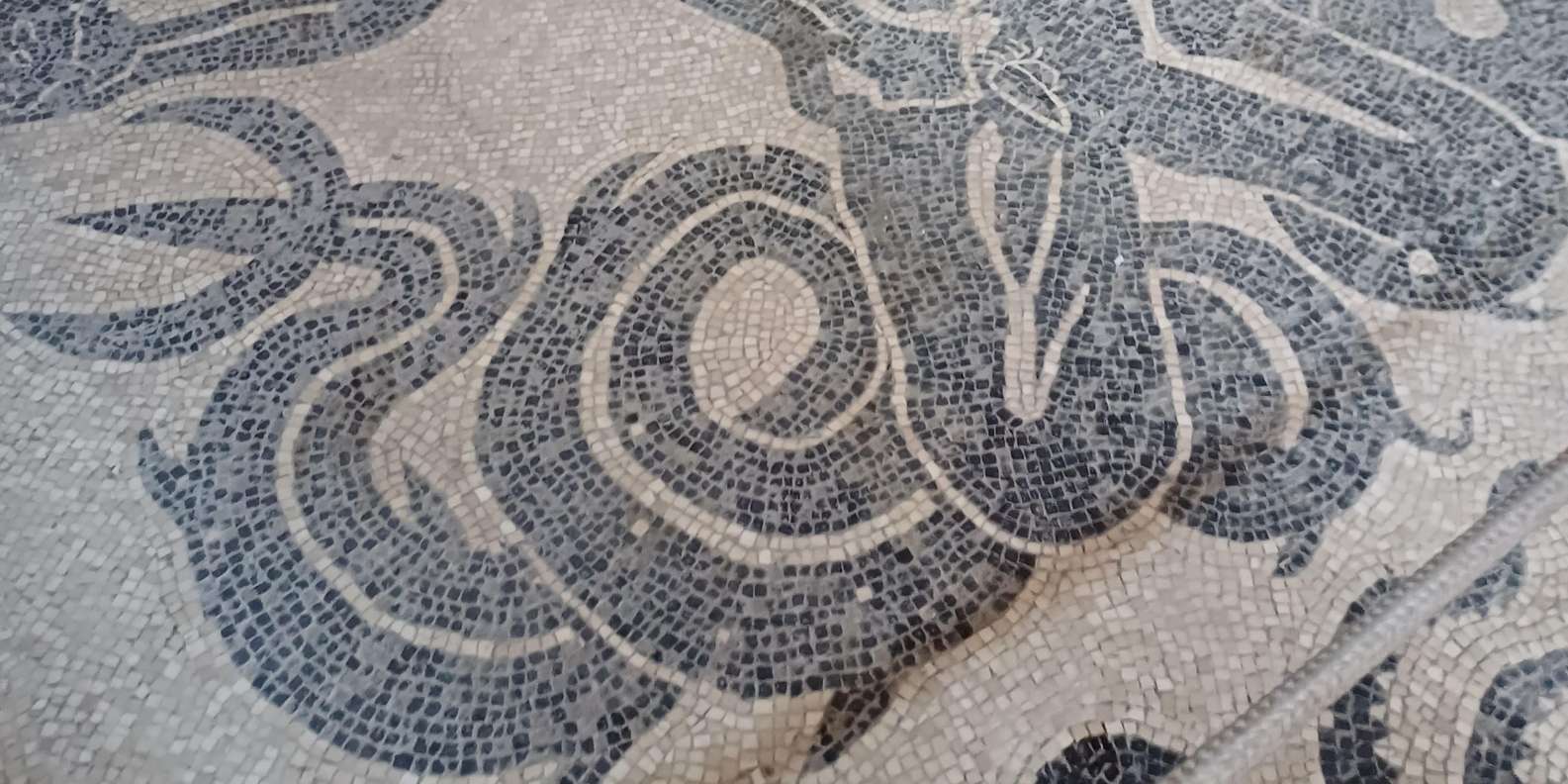
"Very educational visit, we learn a lot of the regular life in those cities and that tragic day, Pompey is enormous, and need a lot more time to see everything, but for a quick visit our guide use a route trying to cover the most emblematic parts"
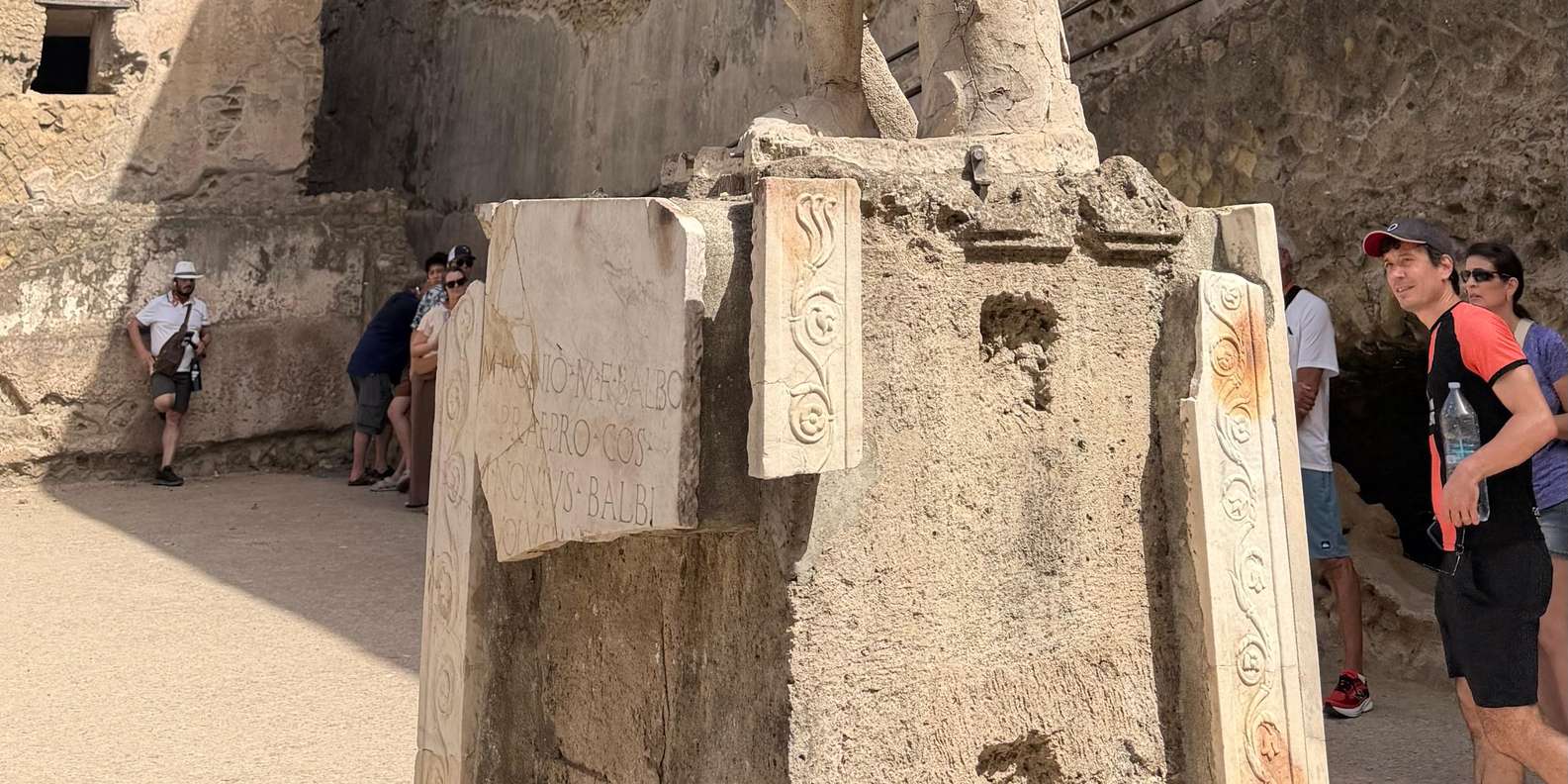
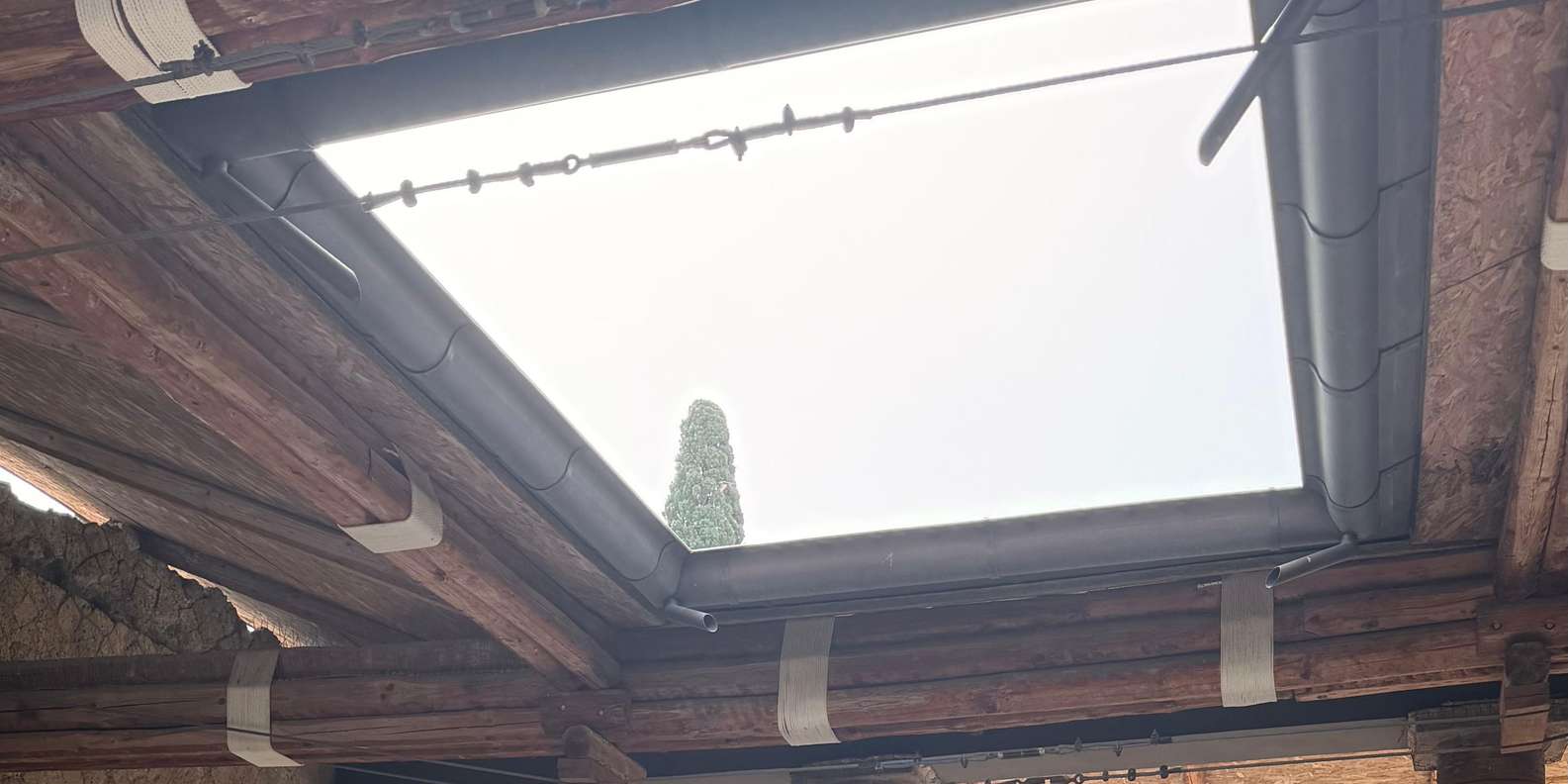
"Fabulous day. Raphael our guide gave us insights into Herculaneum and Pompeii that were fresh and clearly knowledge based. Despite the heat, we were able to absorb Roman life before and after the eruption. Highly recommend this to people looking for insights into the past."
"Raphael was a fantastic guide. Perfect balance of classical historical insight, archaeological knowledge and humour! Everything was seamless with great bus transport with air conditioning. Would recommend to everyone."
Read all 1197 verified reviews
See All ReviewsBook the Two-Site Day Before the Slots Go
Pompeii runs on timed, named entry and the summer slots for combined tours go early. This is the small-group departure from Naples Central Station — archaeologist guide, minibus between the sites, and the entrance tickets to both parks included. Rated 4.8/5 by 1,197 verified guests, with free cancellation up to 24 hours before. Starting from $134 per person.
Check Availability & BookCan't Make These Dates?
Browse More Available Options
Find a tour that fits your schedule — all with instant confirmation and free cancellation.
Pompeii and Herculaneum Tour FAQ
The questions people actually type into Google before booking — answered in the first sentence, explained in the ones after, and sourced where a source exists.
Yes, comfortably — and it is the single most common way people do it, because the two sites sit on the same railway line at the foot of the same volcano. The organised version allocates roughly two hours inside each site plus the transfer between them; our featured departure from Naples follows exactly that shape, running Herculaneum first and Pompeii after a break. What you cannot do in one day is finish Pompeii. It is a 66-hectare walled city and even visitors who loved the day say so — one recent reviewer wrote that Pompeii is huge and that they felt they saw only a small portion of it. A one-day plan buys you the highlights of a very large site and the near-entirety of a very small one. That is a good trade, not a compromise.
About 15 kilometres along the same coastal strip — and, more usefully, exactly 20 minutes apart on the train. Both sites sit on EAV's Circumvesuviana line between Naples and Sorrento, with stops called Pompei Scavi – Villa dei Misteri and Ercolano Scavi. The 20-minute figure is not an average: it repeats identically across the whole published timetable, run after run, all day. Organised tours drive the hop by minibus instead, which takes roughly half an hour depending on the traffic on the coast road. Either way it is the most predictable part of the day — which is why a combined visit is so much easier here than the geography of two separate ancient cities would suggest.
Naples, if you have any choice in the matter — and Sorrento is very nearly as good. From Naples, Pompeii is 29 to 36 minutes on the Circumvesuviana at €3.30 and Herculaneum is 14 to 15 minutes at €2.60, which means the whole day's transport is about ninety minutes and both sites get their full time. From Sorrento it is 33 to 40 minutes to Pompeii on the same line — not the 25 to 30 minutes usually published. Salerno is quietly excellent: the fastest regional train reaches Pompeii in 23 minutes, though it lands in the modern town and you add a €1.50 shuttle. Rome is a genuine twelve-hour day. Positano and Amalfi have no direct public transport to Pompeii at all — the park's own access page lists every connection and there is nothing from the coast — so from there a tour or a private transfer is the only single-vehicle option. Our full origin comparison lays out the numbers side by side.
Get yourself to Napoli Centrale first, then take the Circumvesuviana — and budget an hour and a half each way, two hours in peak season. Ships berth at Stazione Marittima on Molo Angioino, beside Piazza Municipio. Walking to Centrale is 2.6 km and 33 to 40 minutes through heavy traffic with no shade. A taxi is quicker and has an official fixed fare of €15.50 for that run, set by the Comune di Napoli; there is also a fixed fare of €70.00 per vehicle straight from the port to the Pompeii excavations, which is worth doing the arithmetic on for a family. A shared taxi collettivo is €6.00 per passenger, and the cheapest option of all is to walk nine minutes to Piazza Municipio and take Metro Line 1 or Tram 1 two stops. You have to request the fixed fare at the start of the ride — ask afterwards and the meter stands. On a standard port call the daily entry cap at Pompeii is the real risk, so book something that holds your entry rather than queuing on the day.
It is cheap, frequent and direct — and it is not reliable, and you should plan for that rather than be surprised by it. EAV publishes its own monthly report of cancellations and delays over fifteen minutes, and on an ordinary summer afternoon its live departure board shows Sorrento-bound trains running thirty-four to forty-five minutes late. Strikes are frequent, with guaranteed service bands only from 05:30 to 08:30 and 16:30 to 19:30. In March 2026 the director of the Pompeii park went public to say the problem was not the strikes but the daily inefficiencies, after visitors were left stranded in Naples with no information. The line is also a documented pickpocket route with warning signage in the stations. None of this makes it the wrong choice for a confident traveller — board at Porta Nolana, the terminus, to get a seat, validate before boarding, and leave slack. It does mean that on a fixed schedule, such as a cruise call or a same-day flight, the minibus tours are buying you something real.
Herculaneum is better preserved; Pompeii is more impressive. They are not competing for the same reason to visit. Pompeii was buried under metres of pumice and ash that crushed roofs and left an enormous, roofless street plan. Herculaneum was buried by a far deeper flow of volcanic mud that sealed the town — so upper floors, carbonised wooden beams, doors, furniture and painted walls survive there in a way they simply do not at Pompeii. The trade-off is scale: the park itself describes an ancient city of roughly 20 hectares of which just over four are visible, the rest still under the modern town of Ercolano. If you have one afternoon and want to understand what a Roman house was actually like inside, go to Herculaneum. If you want to walk a whole ancient city, go to Pompeii. Seeing both in one day is how you avoid choosing.
As published by the two parks on their own sites: Pompeii charges €20 for the Pompei Express ticket (the ancient city on its own, suburban villas excluded) and €25 for Pompei+, which adds the suburban villas — Villa dei Misteri and Villa di Diomede — plus Villa Regina and the Antiquarium at Boscoreale and the shuttle between them. Herculaneum charges €16. Both parks price EU citizens aged 18 to under-25 at €2, and under-18s of any nationality enter free. If you buy the Express and change your mind on the day, Pompeii sells an upgrade to the villa route for €8, cashless, at the Porta Ercolano gate. Those are euro gate prices from the parks; every dollar figure elsewhere on this page is a tour price from the booking platform and includes guiding and transport as well as entry.
No. There is no state-issued combined ticket, because Pompeii and Herculaneum are two separate autonomous archaeological parks with separate ticketing. This surprises people, because Pompeii does sell a multi-site pass — Pompei Plus at €30, valid three days, covering Pompeii, Oplontis, Villa Arianna, Villa San Marco, the Museo Archeologico di Stabia and Boscoreale. Herculaneum is not in it. The genuine cross-park option is the regional Campania Artecard, whose Campania 3-day card is €41 and includes two free admissions of your choice from a network that contains both parks, with discounts after that. Anything sold online as a single cumulative Pompeii-and-Herculaneum ticket is a reseller bundling two separate tickets, which is also exactly what a combined tour does — with a guide and transport attached.
Yes, and more so than at almost any other Italian site, because Pompeii now runs a hard daily cap. The park publishes a limit of 20,000 visitors a day and issues personal, named tickets. Between 16 March and 14 October it also splits the day: a maximum of 15,000 entries in the 09:00–13:00 window and 5,000 in the 13:00–17:30 window. In practice that means the morning slot on a summer weekend is a finite, sellable thing that runs out. Herculaneum has no equivalent cap. Booking a tour rather than a bare ticket sidesteps the problem entirely — the operator holds the entry. One free-admission exception is worth knowing: Pompeii takes part in the state Domenica al Museo scheme and states that on the first Sunday of each month entry is free with direct and immediate access to the site.
Both parks run a summer and a winter timetable, and the difference matters because the last admission moves by two hours. Pompeii, 16 March to 14 October: opens 09:00, last entrance 17:30, closes 19:00. From 15 October to 15 March: opens 09:00, last entrance 15:30, closes 17:00. Herculaneum, 16 March to 14 October: opens 08:30, last admission 18:00, closes 19:30. Winter: opens 08:30, last admission 15:30, closes 17:00. Pompeii lists 25 December and 1 January as closed but adds unless otherwise communicated — and the Ministry of Culture did in fact announce the Pompeii sites open on 1 January 2026, so check rather than assume. Herculaneum does not publish its closure days on the ticket page at all. In winter the last-admission times are the real constraint on a two-site day: a 15:30 cut-off at both parks is what turns the winter version of this trip into a genuinely tight schedule.
Neither park publishes an official visit duration — what Pompeii does publish are two priced thematic itineraries, Civic Pompeii and Daily Pompeii, each about an hour and a half at €8 on top of the entrance ticket. The working consensus among guides and visitors is 2 to 3 hours for Herculaneum and 3 to 4 hours for a highlights walk of Pompeii, considerably more if you add the suburban villas. Organised two-site days compress that to roughly two hours each, which is why the guiding matters more here than at a single-building attraction: with a fixed two hours in a 66-hectare city, the difference between a good route and a bad one is most of the value. Treat the park's own warning about irregular walking surfaces as a real one and wear shoes accordingly.
Pompeii has three public entrances — Porta Marina Superiore, Porta Marina Inferiore (also signposted Piazza Esedra), and Piazza Anfiteatro. The two Porta Marina gates are the pair nearest the Circumvesuviana stop Pompei Villa dei Misteri, which is the station virtually every tour and independent visitor arrives at from Naples or Sorrento. Piazza Anfiteatro is the far end of the site and pairs with Pompei Santuario on the Naples–Poggiomarino line, or with the Trenitalia station simply called Pompei on the Naples–Salerno line. Getting this wrong costs you a walk around the outside of the city walls, which is longer than it looks. Note that Porta Stabia, which appears on plenty of third-party maps, is not one of the public entrances.
The honest answer is that the ticket saving is smaller than it looks and the routing is worth more than it looks. Gate entry to both sites is €20 plus €16 — real money, but the tour prices on this page also cover a licensed guide, the transfer between the two sites and, on the Naples departures, the round trip from the city. The recurring theme in the reviews is not the ticket, it is the route: guests describe a guide picking a path that covers the emblematic parts of Pompeii inside a short window, and one reviewer specifically credits starting at Herculaneum and doing Pompeii second with having avoided the crowds. If you are a confident independent traveller with a full day, the Circumvesuviana and two gate tickets will do it. If your day is fixed at eight hours and half of it is transport, buy the routing.
It is the park's own cheaper admission, and it is worth knowing what it leaves out before you book. Pompei Express, €20, covers the ancient city only and explicitly excludes the suburban villas — which means Villa dei Misteri, with the famous megalographic frescoes, is not included. Several of the combined tours on this page state plainly in their own listings that the Express ticket is what they provide. That is not a defect; a two-hour guided walk was never going to reach the villas, which sit outside the walls. But if the Dionysiac frescoes of the Villa of the Mysteries are the reason you are coming to Italy, you want the €25 Pompei+ ticket and a longer, Pompeii-only day — or the €8 on-the-spot upgrade at the Porta Ercolano gate. Ask the operator before you assume it is covered.
Herculaneum has the bigger change, and it is genuinely worth timing a visit around. The park reopened the Galleria Martusciello on 15 July 2026 — a scenic passage of over 100 metres that reconnects the modern city level with the ancient shoreline and the fornici, the vaulted boat sheds where the skeletons of the fugitives were found. That shoreline itself reopened in June 2024 after a long drainage and recovery project. It is the most affecting thing at either site and, for the first time in years, it is properly reachable. At Pompeii the news is domestic: the Insula dei Casti Amanti is open on a raised walkway that runs over the whole block, and a run of restored houses has come back — the Domus di Adone Ferito reopened in March 2026, and the frescoed ceiling of the Casa con Panificio was unveiled in July 2026 as part of the park's Dionysian programme for the year.
Not to this day, no. Vesuvius is a summit walk on volcanic gravel with its own timed entry and its own weather, and bolting it onto two archaeological sites produces a twelve-hour day in which nothing gets enough time. Almost every reviewer of the two-site tours mentions the heat as the limiting factor; adding an exposed crater rim to a Campanian summer afternoon is how a good day becomes an endurance test. The sensible pairings are Vesuvius with Pompeii alone, or Vesuvius on a separate day. If that is the trip you are actually planning, our sister site mountvesuviustour.com covers the summit visits properly — including how the crater path and the timed entry work.
The combined tours on this page are not. Every listing we are quoting from says so in its own words — not recommended for people with limited mobility, not suitable for wheelchair users — and one of them notes the walk involved is around a mile at Pompeii and half a mile at Herculaneum, on Roman paving. That is the tour, though, not the sites. Pompeii runs an accessible route, Pompei per tutti, which the park has been extending, and Herculaneum has its own accessibility provision. If mobility is a factor, contact the parks directly about the accessible routes and treat a small-group minibus tour as the wrong product rather than the only product.
Shoes with a real sole, water, and a hat between May and September — in that order. The park's own guide warns about irregular walking surfaces, and Roman street paving is a genuine trip hazard rather than a charming detail. The reviews for these tours are dominated by heat: guests in July and August describe 40°C days, and the ones who enjoyed it are the ones whose guides worked shade into the route. Both featured operators tell you to bring photo ID, and both say the tour runs rain or shine, so a light poncho earns its space in summer too. If you are arriving with luggage, note that the operators recommend leaving it in a station deposit — minibus luggage space is not guaranteed.
No. This is an independent visitor guide. We are not affiliated with, endorsed by or connected to the Parco Archeologico di Pompei, the Parco Archeologico di Ercolano, or the Italian Ministry of Culture, and we use no park emblem or state insignia. Opening hours and gate prices quoted here are read from the parks' own published pages and can change without notice — confirm on pompeiisites.org and ercolano.cultura.gov.it before you travel. The tours and tickets shown on this page are sold by GetYourGuide, and we earn a commission if you book through our links at no extra cost to you. Where a listing carries an official-ticket flag, that flag describes the ticket and its operator — not this website.
Still have questions? Email us at info@pompeiiandherculaneumtour.com